
Federal Ascendancy

“The concentration of power is always accompanied by the corruption of language.” —George Orwell
In the latest issue of The International Economy, Treasury Secretary Scott Bessent provided unprecedented insight into his thinking about the Federal Reserve through both a lengthy article critiquing the central bank’s “gain-of-function” monetary policy and a supplementary interview expanding on his reform agenda. These pieces offer the clearest articulation yet of the administration’s approach to restructuring America’s monetary architecture. While largely ignored by the mainstream media, the article and the interview can help us understand the change in monetary and fiscal dynamics that’s upon us and how investors can adjust to these headwinds that are often painted with the broad brush of uncertainty. However, far from uncertainty, I believe the future of the Federal Reserve and the Treasury’s influence on it is becoming more certain by the day.
Bessent frames his critique around the Fed’s departure from traditional monetary policy tools following the 2008 financial crisis, arguing that quantitative easing and expanded regulatory responsibilities have transformed the institution into something resembling a laboratory experiment with unpredictable consequences for both economic stability and democratic governance. The Treasury Secretary’s analysis centers on what he characterizes as the Fed’s fundamental overreach. He argues that large-scale asset purchases, originally designed as emergency measures, became normalized tools that distorted market signals and created severe distributional consequences across American society. His data is damning: during the first six years of unconventional policy implementation, the Fed’s average forecast error for real GDP was 0.6 percentage points for one-year projections and 1.2 percentage points for two-year projections. Cumulatively, the Fed overstated economic growth by 7.6 percent over two years, projecting an economy more than $1 trillion larger than what materialized in reality. These repeated misses, Bessent contends, reveal an institution placing excessive faith in its own abilities while deploying tools it fundamentally doesn’t understand.
More problematically, Bessent identifies how the Fed’s unconventional policies created what amounts to “socialism for investors, capitalism for everyone else.” Interestingly, this is something Bernie Sanders would agree with. He has often lamented the state of American economy as Socialism for the rich and rugged capitalism for everyone else. Populism makes for strange bed fellows. Anyway, Bessent is arguing that the wealth effect that quantitative easing was designed to generate worked primarily for asset owners, while lower-income households faced both higher inflation and reduced access to homeownership as asset prices soared beyond their reach. This distributional impact occurred not through conscious policy design but as an inevitable consequence of policies that mechanically inflated asset values without corresponding increases in productive economic output.
Bessent’s reform recommendations appear straightforward: return to narrow mandate focus, halt routine use of unconventional tools, conduct comprehensive institutional review, restore separation between monetary and regulatory functions, address operational bloat, and restructure monetary tools with explicit costing considerations. Each proposal reads as common-sense institutional housekeeping designed to restore the Fed’s credibility and independence. The Treasury Secretary emphasizes repeatedly that good stewardship cannot be achieved through rhetoric alone but requires evidence-based assessment of institutional performance and willingness to acknowledge past mistakes.
Yet examining these recommendations through a critical lens reveals their true character: a systematic transfer of monetary authority from independent central bank technocrats to elected government officials and executive branch agencies. The mission creep criticism effectively argues that distributional decisions should be made by democratically accountable authorities rather than unelected Fed officials. While this sounds democratic in principle, it means the federal government assumes direct control over economic winners and losers rather than allowing market mechanisms to operate with central bank oversight. Similarly, the call to halt quantitative easing and return to simple interest rate tools transfers effective control over money supply and credit allocation to fiscal authorities who can manipulate these levers through spending and taxation decisions.
The recommendation for comprehensive institutional review becomes particularly revealing when considered alongside other administration priorities. Who exactly would conduct this review, and what criteria would determine appropriate Fed boundaries? The logical answer points toward Treasury-led assessment that would define central bank limitations according to broader government policy objectives. Institutional specialization, framed as returning bank supervision to traditional agencies like the FDIC and OCC, removes Fed oversight that might resist government mandates on banking institutions. The seemingly reasonable focus on operational efficiency and cost control actually diminishes Fed capacity for independent research and policy development that might contradict administration preferences.
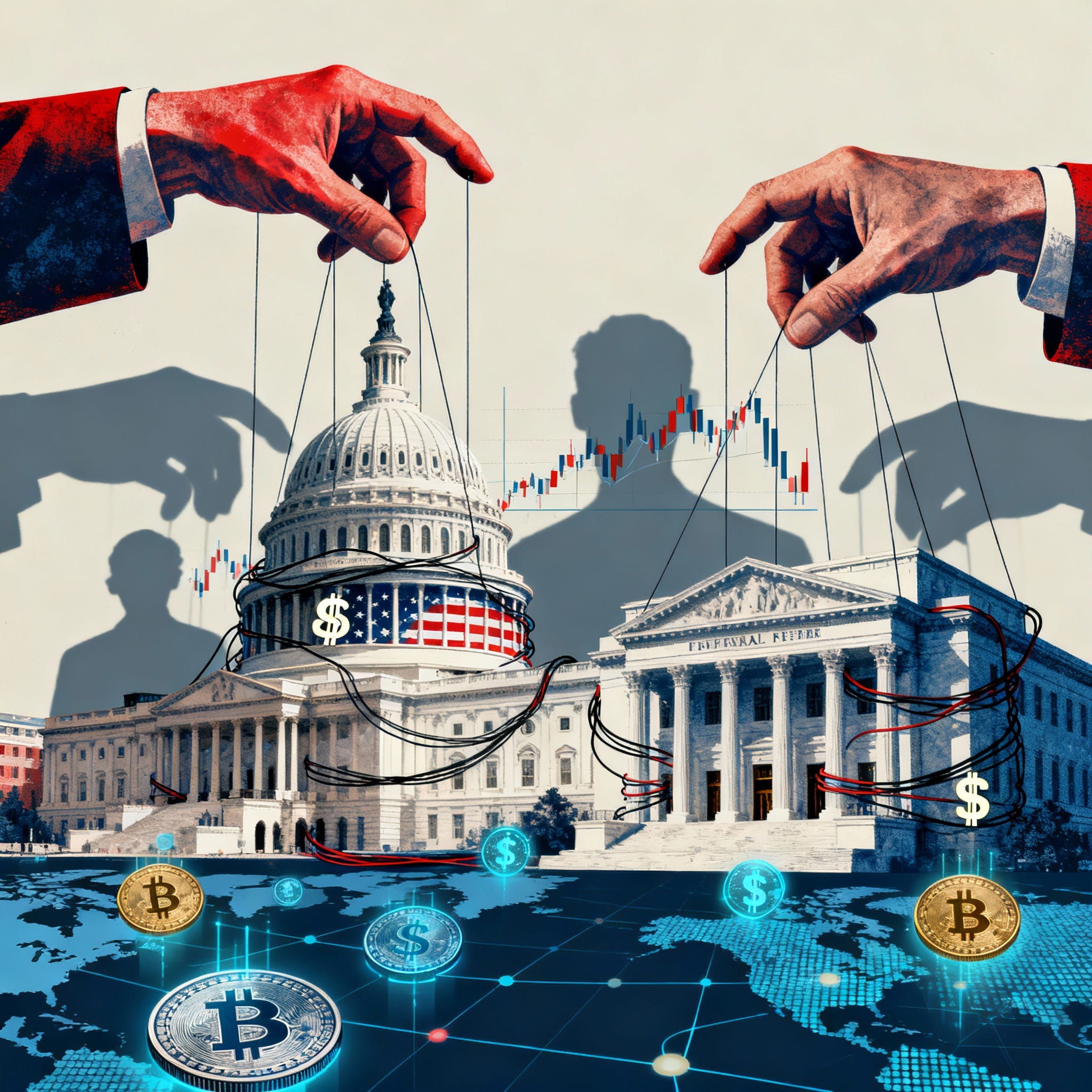
Most significantly, the suggested restructuring of monetary tools with costing considerations could transform the Fed’s fundamental role from systemic stabilizer to profit center for government operations. Bessent notes that the Fed currently loses approximately $100 billion annually as interest rates paid on reserves exceed yields on its securities portfolio. His proposed solutions—including having the Fed pay interest to Treasury on the Treasury General Account and requiring rigorous cost-benefit analysis for all unconventional policies—explicitly subordinate monetary policy to fiscal considerations. When market intervention becomes too expensive for the Fed to undertake independently, those responsibilities naturally migrate to Treasury and other government agencies with broader funding sources and political mandates.
This transformation occurs within a broader context that makes Fed independence increasingly untenable regardless of reform efforts. The United States now faces what can only be characterized as emerging fiscal dominance, where government debt levels force monetary policy into accommodation of Treasury financing needs. With annual deficits approaching $2 trillion and interest payments totaling $1.1 trillion, each Fed rate increase directly amplifies government borrowing costs in a perverse feedback loop. The Fed finds itself caught between its price stability mandate and the practical reality that aggressive monetary tightening could destabilize government debt markets and trigger broader financial crisis.
I first wrote about the rising threats to the federal reserve independence some months back and compared the current period as moving closer to the period before 1950s growth era.
The United States’ own history provides a stark precedent. During the 1965-1981 “Guns and Butter” era, 4%+ deficits funded the Vietnam War and Great Society programs. Despite the Federal Reserve raising rates from 4% to 20% over this period—and without any quantitative easing—core inflation still skyrocketed from 1.4% to 13.5%. Crucially, today’s economy faces this pressure with weaker shock absorbers: productivity growth has halved to 1.8% annually compared to the 1960s’ 3.4%, making each dollar of deficit spending more inflationary.
So, the 1951 Treasury-Fed Accord that established central bank independence may increasingly be viewed as a historical anomaly rather than a permanent institutional arrangement. Current developments suggest a gradual return to fiscal dominance, accomplished not through dramatic confrontation but via administrative coordination that maintains the appearance of Fed independence while subordinating its practical decision-making to broader government priorities.
Bessent’s reforms represent one component of a much larger transformation toward American etatism—a system where the state exercises decisive control over economic life through fiscal dominance, monetary centrality, and executive discretion.

This architecture has emerged through crisis response rather than ideological design, with each intervention expanding state capacity and creating dependencies that outlast the emergencies that justified them. The 2008 financial crisis normalized massive government intervention in markets. The COVID-19 pandemic demonstrated that federal authorities could, when necessary, replace entire sectors of economic activity through direct spending. Each crisis response left behind tools and precedents that enabled subsequent interventions on an ever-larger scale.
The etatist architecture now extends far beyond monetary policy into sovereign wealth funds that give government direct ownership stakes in critical industries, strategic reserves in digital assets that redirect resources according to state command, export duties on technology companies that generate revenue streams bypassing traditional legislative appropriation, and trade agreements that function as directed capital flows rather than mutual benefit arrangements. Europe has committed $750 billion in energy purchases and $600 billion in investments by 2028 not through negotiated reciprocal benefits but as mandated transfers administered through executive discretion and tariff threats. Japan pledged $550 billion in targeted investments under similar coercion. These arrangements blur traditional boundaries between public and private sectors, with corporate profits becoming state revenue through administrative decree rather than democratic process.
The consolidation of regulatory power under Treasury coordination represents a crucial component of this broader architecture. Rather than overtly merging banking regulators, which would require congressional approval, the administration pursues what Bessent describes as “coordination via Treasury, such that our regulators work in unison from the same song sheet.” This approach effectively centralizes regulatory authority without requiring legislative changes, allowing Treasury to assert control over Fed, OCC, and FDIC policy through administrative coordination rather than formal consolidation.
The geopolitical implications of this monetary centralization extend are stark. As Treasury assumes greater control over Fed operations, traditional central bank tools become instruments of broader government strategy in ways that would have been unthinkable under genuinely independent monetary policy. The Fed’s dollar swap lines with major central banks—currently providing liquidity support to the European Central Bank, Bank of Japan, Bank of England, Swiss National Bank, and Bank of Canada—transform from technical monetary operations into mechanisms of geopolitical influence when administered under Treasury coordination.
Recent examples demonstrate how this dynamic operates in practice. Argentina’s peso crisis prompted Treasury pledges of “large and forceful” support including potential swap agreements and direct currency purchases, with Bessent explicitly linking this assistance to broader U.S. strategic objectives in the region. Korea faces similar currency pressures that have generated discussions of swap line support, particularly as trade agreements pull capital away from allied economies and expose them to currency instability. Rather than coincidental policy responses, these interventions follow a clear pattern where American trade policies generate currency weakness in allied economies, which the U.S. then addresses through dollarization mechanisms that increase dependency on American monetary institutions.
The emergence of regulated stablecoins as instruments of global dollarization represents perhaps the most significant development in this evolving architecture. Bessent projects that stablecoins could reach a $3.7 trillion market capitalization by end of this decade, backed primarily by U.S. Treasuries and creating massive demand for government securities. This transforms digital assets from market innovations into tools of monetary statecraft, enabling unprecedented control over global capital flows. Unlike the Eurodollar system that left much offshore dollar circulation beyond Washington’s direct oversight, regulated stablecoins can be programmatically managed, censored, or surveilled at the protocol level, giving American authorities real-time monitoring and selective enforcement capabilities over international transactions.

The stablecoin framework creates what amounts to a systematic approach to global dollarization. Countries facing currency instability increasingly confront a choice between maintaining monetary independence and accessing dollar liquidity through stablecoin adoption. Trade policies that extract capital from allied economies create the currency weakness, while stablecoin infrastructure provides the technological mechanism for digital dollarization. The result is a self-reinforcing system where economic dependencies translate into monetary subordination, with the dollar’s role expanding not through traditional reserve accumulation but via direct adoption of dollar-denominated digital assets for domestic transactions.
This transformation carries profound implications for investment strategy that extend well beyond traditional monetary policy analysis. When the federal government exercises decisive control over economic life, investment returns become driven by state priorities rather than market mechanisms. The conventional wisdom of “don’t fight the Fed” evolves into “don’t fight the government” as monetary policy, fiscal policy, and regulatory oversight align under executive coordination. Market forces that traditionally disciplined political overreach become muted when institutional plurality gives way to consolidated authority.
Government preferences become paramount in asset selection, with sectors receiving state support vastly outperforming those facing official indifference or hostility. The administration’s explicit support for Bitcoin and cryptocurrency generally has translated into massive returns for investors aligned with these positions. Understanding which companies receive state favor—evident in recent White House CEO dinners that increasingly resemble the coordination meetings characteristic of state-directed economies—becomes crucial for portfolio construction. American multinational corporations function less as independent market actors and more as arms of etatist policy, with their success tied directly to their alignment with broader government objectives.
The heightened risk to contrarian strategies reflects the elimination of institutional checks and balances that previously created opportunities for investors to profit from policy mistakes or government overreach. When monetary authorities, fiscal authorities, and regulatory agencies operate under unified command, traditional arbitrage opportunities between different policy domains disappear. Similarly, the currency dimension adds structural headwinds for non-dollar assets as dollar weaponization increases through stablecoin proliferation and conditional swap line access. Countries seeking to maintain monetary sovereignty face increasingly stark choices between financial isolation and digital dollarization, with most finding the latter option more attractive despite its implications for long-term independence.
The investment landscape that emerges from this analysis rewards alignment with government priorities while punishing independence or contrarian positioning. Sectors that serve state objectives—defense, technology aligned with national competitiveness, energy independence, domestic manufacturing—benefit from policy support that translates directly into superior returns. Conversely, sectors that conflict with government priorities or require regulatory independence may face structural headwinds regardless of their fundamental economic prospects. The traditional investment approach of analyzing companies and sectors based on market dynamics becomes secondary to understanding political priorities and positioning accordingly.
This represents more than a temporary policy shift that might reverse with future elections or economic cycles. The institutional changes that Bessent’s reforms would accomplish, combined with the broader architecture of American etatism, create path dependencies that make reversal increasingly difficult. Once monetary policy becomes subordinated to fiscal needs, once regulatory agencies operate under Treasury coordination, once global dollarization proceeds through stablecoin adoption, the constituencies that benefit from these arrangements develop vested interests in their continuation. The erosion of institutional independence may deliver short-term economic benefits and geopolitical advantages, but it fundamentally alters the American political economy in ways that prove resistant to subsequent reform efforts.
The concentration of financial power in federal hands may indeed revitalize American economic performance and extend dollar hegemony globally, as Bessent and other administration officials argue. But history suggests that such consolidation typically carries costs that become apparent only after institutions capable of providing alternative perspectives have been subordinated or eliminated. The Fed reforms may restore central bank credibility in the short term, but they risk creating a monetary system where credibility depends entirely on political authority rather than institutional independence—a foundation that has proven fragile across different times, places, and political systems. Whether American etatism proves more durable than historical alternatives remains an open question, but its emergence appears increasingly irreversible as each crisis response expands state capacity and each expansion enables further intervention in an ascending spiral of government control over economic life.