
Crypto Goes Mainstream
A Primer on Digital Asset Market Structure and Investor Protection Act

When Representative Don Beyer first introduced the Digital Asset Market Structure and Investor Protection Act in September 2023, the crypto industry was still reeling from a year of spectacular failures—FTX’s collapse, Terra’s implosion, and the cascading liquidations that had erased hundreds of billions in nominal value. The bill arrived not as a response to euphoria but as an attempt to impose order on wreckage, to convert ad hoc enforcement actions and fragmented state-level efforts into a coherent federal regime that could both discipline the sector and anchor it within American jurisdiction. By late 2025, that early draft has evolved into the centerpiece of a broader legislative push encompassing the Financial Innovation and Technology for the 21st Century Act, the CLARITY Act, and the recently enacted GENIUS Act on stablecoins, collectively forming the most significant reordering of digital asset oversight since the creation of the securities and commodities regulatory frameworks nearly a century ago.
The immediate catalyst for action was jurisdictional warfare between the Securities and Exchange Commission and the Commodity Futures Trading Commission, each asserting expansive authority over crypto assets while leaving market participants in legal limbo. The SEC under Gary Gensler had pursued an enforcement-first strategy, also called regulation by enforcement, treating most tokens as unregistered securities and bringing high-profile cases against exchanges, issuers, and even decentralized protocols, arguing that existing securities law—particularly the Howey test for investment contracts—already covered the field. The CFTC, by contrast, claimed jurisdiction over digital commodities but lacked statutory authority to regulate spot markets, leaving a regulatory gap that allowed unregistered offshore platforms to dominate trading volumes while nominally serving US customers. This stalemate was not merely administrative; it was structural, reflecting deeper uncertainty about whether crypto tokens were primarily capital-formation instruments akin to equity or functional commodities embedded in decentralized networks, and whether the governance ethos of those networks—open-source, permissionless, globally distributed—was compatible with disclosure-driven, intermediary-centric US regulatory models.
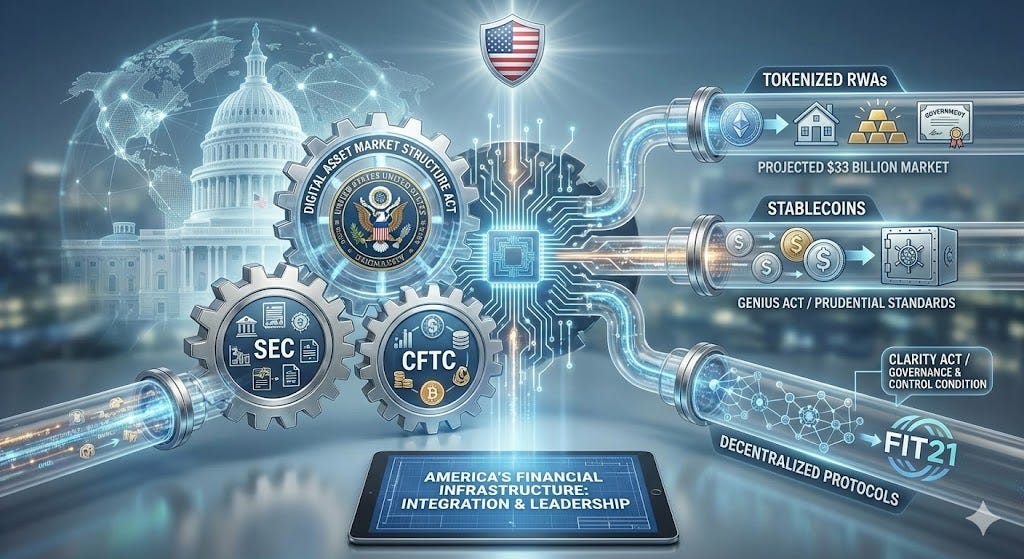
The Digital Asset Market Structure and Investor Protection Act, alongside FIT21 and CLARITY, resolves that impasse by constructing a three-bucket taxonomy that separates the token from the investment contract and assigns each category to a different regulator.
Digital commodities—blockchain-native assets intrinsically linked to the operation of a decentralized system—fall under CFTC oversight once the underlying network meets statutory tests for functionality and lack of centralized control.
Investment contract assets occupy an intermediate zone: sold under securities-style disclosure initially, but eligible to migrate into the commodity bucket once they can be transferred peer-to-peer without reliance on an intermediary and the issuer’s essential efforts have receded.
Permitted payment stablecoins are carved out as a separate class governed by the GENIUS Act and banking-style prudential standards, while tokenized traditional securities remain squarely under SEC jurisdiction regardless of the ledger they sit on.
This architecture does not eliminate regulatory discretion—the boundaries of decentralization, functionality, and essential efforts remain contestable—but it shifts the locus of control away from case-by-case enforcement and toward statutory definitions, registration pathways, and joint rulemakings that privilege industry access over gatekeeping.
At the heart of this reordering lies a definition of decentralization designed less as an ideological principle and more as a governance and control condition for when a blockchain system no longer has a controlling person or group. Under CLARITY, a mature blockchain system is one that is not controlled by any person or group of persons under common control, with decentralized governance defined as a transparent, rules-based mechanism where participation is open and not effectively dominated by a single actor or affiliated bloc.
The Digital Asset Market Structure and Investor Protection Act goes further, specifying that the ledger must resist modification or tampering by any single person or persons under common control, that issuance rules must be programmatic, and that transfers must occur peer-to-peer without an intermediate custodian. This is not a quantitative threshold—no Nakamoto coefficient is mandated—but rather a functional test focused on whether any identifiable party retains the practical ability to halt, roll back, or meaningfully reparameterize the chain. If two validators acting together can effectively alter the ledger or governance at will, regulators will almost certainly treat them as a single controlling group, meaning the network remains centralized in substance and the token does not qualify for commodity-style treatment.
The policy objectives beneath these design choices extend well beyond resolving a turf battle between agencies. The administration’s White House report on digital assets and the President’s Working Group on Digital Asset Markets frame the legislation as critical infrastructure for maintaining American leadership in financial technology, pre-empting regulatory arbitrage to offshore venues, and extending dollar dominance through tokenized stablecoins and programmable collateral.
It is telling that crypto is not an alternative to the existing financial system anymore but a parallel layer that must be channeled into US-regulated intermediaries, subjected to anti-money-laundering and sanctions enforcement, and normalized as a legitimate asset class eligible for institutional portfolios and derivatives markets. The CFTC’s newly launched digital assets pilot program, which permits Bitcoin, Ether, USDC, and tokenized Treasuries as collateral in derivatives markets, exemplifies this integration: previously speculative instruments are being absorbed into the plumbing of mainstream finance, with strict segregation, reporting, and risk-management conditions that make them legible to prudential supervisors while expanding their utility for hedge funds, market-makers, and corporate treasuries.
This pivot toward integration and industrialization reveals the legislation’s deeper alignment with contemporary American economic strategy. Facing slower potential growth, high public debt, and rising geopolitical competition, policymakers are betting that tokenization of real-world assets, programmable stablecoins, and on-chain settlement infrastructure can deliver productivity gains in capital markets, reduce frictional costs in cross-border payments, and create new tools for projecting US regulatory influence abroad. The RWA tokenization market has surged from approximately $8.5 billion in early 2024 to over $33 billion by mid-2025, driven by institutional adoption of tokenized Treasuries, private credit, and real estate, with BlackRock’s BUIDL fund alone attracting over one billion dollars and serving as a proof-of-concept for how traditional asset managers can leverage blockchain rails for twenty-four-seven trading, fractional ownership, and programmable compliance. By blessing these instruments as eligible collateral and establishing registration paths for platforms that intermediate them, the legislation effectively nationalizes a parallel market infrastructure that had been developing offshore, turning what was a regulatory void into a supervised domain where US authorities can monitor flows, enforce sanctions, and set standards that other jurisdictions may follow.
The bills get several things right from a systemic and institutional perspective:
They acknowledge that ad hoc enforcement cannot substitute for legislative clarity when an asset class reaches material scale—crypto’s total market capitalization exceeds two trillion dollars, and tokenized RWAs are projected to represent ten percent of global GDP by 2030, making regulatory limbo both untenable for industry and dangerous for financial stability.
The framework recognizes that tokens evolve: what begins as a centralized fundraising mechanism can, if genuine decentralization is achieved, transition into a commodity-like instrument where issuer disclosure obligations fade and platform surveillance becomes the primary regulatory lever. This dynamic classification, while operationally complex, reflects the economic reality that crypto networks mature over time, and regulatory treatment should adapt accordingly rather than locking in initial status indefinitely.
The legislation imports proven safeguards—segregation of client funds, capital and margin requirements, anti-fraud and anti-manipulation rules, surveillance and record-keeping obligations—from securities and derivatives markets into the digital asset context, reducing the risk that another FTX-style commingling of customer and proprietary assets could occur within a registered US entity.
Yet the framework leaves critical questions unanswered and creates new gaps that may prove as problematic as the jurisdictional uncertainty it seeks to resolve. Most glaring is the treatment of decentralized finance protocols and self-custodial wallets, which the bills acknowledge but largely exempt from registration and intermediary-style obligations. CLARITY, for example, exempts persons compiling or validating network transactions, providing computational work, offering user interfaces for blockchain systems, or developing trading protocols and software, provided they are not acting as traditional intermediaries. This carve-out is designed to avoid stifling open-source development and to recognize that DeFi protocols, if genuinely decentralized, lack a single accountable entity to register or supervise. But it also creates a regulatory perimeter that illicit actors can exploit: if a protocol’s governance is sufficiently diffuse or pseudonymous, enforcement becomes nearly impossible, and the Treasury’s own DeFi risk assessment warns that many existing DeFi services covered by the Bank Secrecy Act fail to comply with anti-money-laundering obligations, a vulnerability that criminals actively exploit. The only way to overcome this is by promoting Decentralized Identities (DiDs) or Proofs of Personhood (PoPs), about which the legislation says very little. But more on that later.
Another unresolved area is custody and operational risk for tokenized real-world assets. The legislation directs the SEC and CFTC to establish rules for qualified digital asset custodians, segregation standards, and capital buffers against operational risk, but it does not prescribe how those standards should differ from traditional custody or how legal enforceability of on-chain ownership claims will be harmonized across jurisdictions. As the Bank for International Settlements notes,
Tokenized assets promise real-time settlement and automated processes but come with risks including liquidity risk, credit risk embedded in smart contracts, and the challenge of ensuring that legal ownership recorded on-chain is recognized by courts and bankruptcy regimes.
The bills also relocate, rather than abandon, oversight of stablecoins. The GENIUS Act establishes a federal framework for payment stablecoins—mandating 1:1 high‑quality reserves, ongoing audits, risk‑management and governance standards, and direct supervision of issuers by prudential regulators under Treasury’s umbrella—while the market‑structure legislation generally treats those same instruments as neither securities nor commodities, narrowing the SEC’s and CFTC’s roles to products built on top of them and leaving day‑to‑day conduct, safety‑and‑soundness, and illicit‑finance risks primarily to the Treasury. This is very much in line with what I have been arguing about in my American Etatism thesis and something I covered in my analysis of the GENIUS act where I wrote:
As governments lose control over the long end of the yield curve and, by extension, the traditional levers of fiscal and monetary policy, the locus of power shifts decisively toward private capital and digital asset holders. The loss of government control over long-term finance is not just a technical issue—it signals a broader erosion of public trust and a redrawing of the social contract. In every technological disruption, there are those who seek to take advantage of tragedy, and in this era, the stakes are nothing less than the structure (and fracture) of economic and social power itself.
What It Means for Investors?
From an investment perspective, the legislation’s architecture channels capital toward three broad categories:
Tokenized real-world assets and related infrastructure
High-quality collateral assets that are explicitly moving into the derivatives stack
Scalable base layers capable of hosting data-intensive and AI-adjacent use cases under US-compliant custody and intermediation.
The RWA theme is most directly supported: tokenized Treasuries, money-market funds, and private credit instruments are being blessed as eligible collateral, institutional asset managers are launching on-chain funds at scale, and the regulatory path for issuance and secondary trading is becoming clearer with each joint SEC-CFTC rulemaking. BlackRock’s BUIDL fund, which tokenizes US Treasuries and has attracted over two billion dollars across multiple blockchains, serves as the archetype—an established brand leveraging blockchain for operational efficiency while remaining firmly within traditional prudential oversight. Similar structures from Apollo, Mastercard, JPMorgan, Citi, and Goldman Sachs in tokenized credit, real estate, and internal settlement are proliferating, and the legislative framework accelerates that trend by normalizing tokenized instruments as acceptable for institutional portfolios, derivatives margin, and cross-border payments.
For high-quality collateral assets, the CFTC pilot is the clearest signal: Bitcoin, Ether, and USDC are now explicitly permitted as collateral in derivatives markets, with strict segregation, valuation, and reporting conditions that ensure prudential supervisors can monitor exposures and intermediaries can manage risk. On numerous occasions, I have highlighted the biggest use of Bitcoin being collateral like when I wrote here
As the world grapples with unprecedented levels of debt, stagnating economic growth, and the limitations of traditional collateral, it is clear that the status quo is unsustainable. The expansion of the economic frontier into the digital realm offers a pathway out of this quagmire, driven by innovations in technology and the rise of digital assets. However, this new frontier requires a foundation of robust, reliable collateral to support its growth, and Bitcoin is uniquely positioned to fulfill this role.
or here
The existing credit market infrastructure, built around traditional collateral assets and their associated intermediation chains, faces disruption from Bitcoin’s unique properties. Current collateral flows rely heavily on bank-affiliated broker-dealers acting as intermediaries in bilateral repos, triparty repos, and cleared transactions through central counterparties. These systems involve complex transformations—credit, liquidity, and risk—that enable less creditworthy participants to access funding and less liquid assets to be structured into liquid instruments. However, Bitcoin’s programmable nature and instant settlement capabilities threaten to eliminate many of these intermediation layers, reducing costs but also destroying established business models. The velocity of collateral—how frequently it can be reused across different transactions—increases dramatically with Bitcoin due to its 24/7 availability and instant settlement, potentially amplifying leverage in the system while reducing the need for traditional collateral intermediaries.
And of course, almost every week I write a note about Bitcoin as collateral. Now you have it as legislation.
The bill materially lowers friction for institutions to use BTC and ETH the way corporate treasuries like MicroStrategy do on balance sheets and the way hedge funds do in repo-like and derivatives contexts, while the broader market-structure bills create registration paths for platforms that want to intermediate this collateral inside the US perimeter rather than offshore. The open question is how far beyond BTC, ETH, and major stablecoins regulators will go: the current posture is asset-by-asset and highly conservative, so blue-chip, liquid assets with deep derivatives markets are obvious candidates, while smaller or governance-only tokens are unlikely to qualify as permissible collateral for systemically important institutions any time soon.
Scalable infrastructure plays are the third category, particularly base layers and rollup ecosystems that can support tokenized sovereign and credit products under US law, along with data- and compute-heavy workloads including AI verification, model provenance, and supply-chain telemetry. The White House digital-assets report and Treasury work on tokenized Treasuries both stress high throughput, robust finality, strong auditability, and compatibility with know-your-customer, anti-money-laundering, and data-governance requirements as prerequisites for serious institutional use. That naturally favors networks that can plug into US-regulated custodians and intermediaries while handling enterprise-scale transaction volumes, and it advantages middleware that enables cross-network interoperability and settlement flexibility—though bridge protocols and cross-chain messaging layers must pass stringent security, recoverability, and legal enforceability tests to avoid being structurally excluded from institutional flows. Not financial advice, but many L1s should appear as prospective opportunities. Ethereum is the oldest but new L1s with high throughput like Solana, Avalanche, Sui, or L0s like Polkadot are good opportunities.
Digital identity, decentralized identifiers, and proof-of-personhood occupy a more speculative position. Federal reports on digital assets and election integrity flag verifiable identity and authenticity layers as necessary to manage AI-driven content and social manipulation, yet there is visible discomfort with pushing sensitive identity data onto public chains, and no clear statutory preference for decentralized identifiers over platform-centric or government-backed systems. That suggests upside optionality rather than a near-term regulatory catalyst: if large social platforms or enterprise software providers adopt crypto-native DID standards as a way to comply with forthcoming authenticity or anti-bot rules, those standards and their underlying chains could benefit, but the bills themselves do not force that outcome, and the absence of a federal mandate means adoption will be driven by private-sector choices and fragmented state-level initiatives rather than by coordinated policy. Not financial advice, but if you’re interested in DiDs or PoPs, check out ENS, World Coin, Concordium, and Polkadot.
Interoperability, similarly, is treated as a design requirement for systemically relevant tokenization rather than as a separate investable theme regulators want to pick winners in. The Treasury’s work on digital assets emphasizes cross-network interoperability and settlement flexibility as conditions for tokenized Treasuries to function across multiple distributed-ledger platforms, but it stops well short of endorsing specific bridge protocols or messaging standards, reflecting ongoing concerns about smart-contract risk and cross-chain exploits. For investors, that makes middleware a barbell: core, standards-setting messaging or bridging layers that win institutional buy-in could become critical infrastructure, but anything that cannot pass prudential scrutiny on security, recoverability, and legal enforceability will be structurally excluded from the flows this legislation is trying to channel, meaning only a handful of interoperability solutions are likely to capture the value created by regulatory normalization. Not financial advice, but if you’re interested in interoperability, check out Chainlink and Polkadot.
What it Means for Macro?
Seen through the lens of etatism and the consolidation of state power over finance, the crypto market structure legislation exemplifies a broader trend: the absorption of would-be parallel systems into existing hierarchies of authority, dressed in the language of innovation and competitiveness. What began as a libertarian experiment in censorship-resistant money and permissionless finance is being recast as a set of efficiency upgrades for incumbent capital markets, with decentralization redefined not as exit from state oversight but as a technical condition that determines which regulator supervises which intermediary. The CFTC gains spot-market authority it has long sought, the SEC retains control over initial offerings and centralized networks, and both agencies are directed to coordinate closely on joint rulemakings, portfolio margining, and cross-border sandboxes—a pattern of regulatory consolidation that mirrors the post-Dodd-Frank integration of derivatives oversight but now extended to a new asset class and new technological substrate.
For those tracking the macro stakes, the legislation’s real significance lies not in the classification tests or registration pathways but in the way it positions digital assets as a tool of American statecraft. Stablecoins and tokenized Treasuries are explicitly framed as mechanisms to sustain dollar dominance in a world where fiscal constraints and geopolitical competition make traditional tools of economic power more contested, and the bills create pathways for these instruments to become standard collateral in global derivatives and wholesale payments—channels through which US supervisors can monitor flows, enforce sanctions, and set standards that other jurisdictions may adopt or face exclusion from. If US-regulated stablecoins and tokenized Treasuries become the de facto standard for cross-border settlement and derivatives margin, the United States extends both dollar primacy and its supervisory reach into new transactional layers, even as the underlying technology promises decentralization and disintermediation. That paradox—channeling supposedly permissionless infrastructure into state-supervised intermediaries as a condition of legitimacy and market access—defines the legislation’s essential character and its alignment with the administration’s broader agenda of maintaining American preeminence in a fragmenting global order.
The distributional consequences for market participants are stark and path-dependent. Well-capitalized exchanges, custodians, and market-makers capable of satisfying CFTC registration, segregation, and risk-management requirements stand to benefit from the consolidation of activity into a smaller number of compliant venues, while smaller DeFi-adjacent platforms and non-custodial services may find the compliance overhead prohibitive or the exemptions too narrow to operate at scale. Large issuers of payment stablecoins and tokenized real-world assets are positioned to leverage the new regime to embed their instruments in institutional portfolios and derivatives markets, turning regulatory blessing into a structural funding and franchise advantage that smaller or offshore competitors cannot replicate.
For policymakers, investors, and observers of the evolving financial system, the practical task is to treat the legislation less as an endpoint and more as a diagnostic of power and priorities. Key signals to monitor include how aggressively the CFTC uses its expanded mandate and fee-funded capacity to police spot digital commodity markets relative to historic commodity enforcement, whether the SEC tests the boundaries of the decentralization thresholds through new guidance or litigation, and how quickly regulated stablecoins and tokenized Treasuries penetrate collateral, repo, and derivatives markets.
The central question is who ultimately captures the regulatory arbitrage the bills create: if it is mainly large incumbents and a handful of well-connected crypto platforms, the result will be further consolidation and financialization of the sector under a relatively light-touch commodity regime; if, instead, supervisors leverage their new authorities to impose genuine prudential and conduct constraints, the legislation could yet evolve into a more robust, if idiosyncratic, model of digital asset governance that balances innovation with systemic stability.
What is already clear is that the legislation marks an inflection point in how the United States approaches crypto—not as a fringe experiment to be tolerated or suppressed, but as infrastructure to be absorbed, standardized, and wielded in the service of national economic strategy. The framework does not resolve every ambiguity or close every gap, but it does establish the principle that digital assets, like every other form of finance before them, will be brought within the perimeter of state supervision and made legible to prudential authorities as a condition of legitimacy and market access. In that sense, the crypto market structure bill is less a concession to industry demands for clarity and more a reassertion of state primacy over the architecture of capital, dressed in the language of competitiveness and innovation but animated by the imperative to ensure that no parallel financial system develops beyond the reach of American regulatory power and geopolitical leverage.
❤️ Like this post to bet on the future!
