
The Bitcoin Prophecy

This Substack can trace its origins to a Medium post I wrote last September, well before I ever considered writing regularly. That post marked my first serious foray into macro analysis, and it remains a piece I’m genuinely proud of. While the subject was Bitcoin, my motivation came less from the cryptocurrency itself and more from the relentless noise swirling around it: bold claims about dethroning the dollar as the world’s reserve currency, Michael Saylor’s headline-grabbing buying spree, and talk of “insatiable” ETF demand. Amid the market frenzy, I wanted to step back and ask: from an economic and monetary perspective, where does Bitcoin truly fit in this rapidly evolving landscape? I landed on the idea of Bitcoin as collateral—a use case that, given how new Bitcoin still is, could ultimately prove as significant as the oft-cited narratives of “digital gold” or a new world reserve currency. Here’s an excerpt from that original article:
Bitcoin’s unique properties will make it an exceptional global collateral asset. By using Bitcoin as collateral, lenders and financial institutions can enhance economic efficiencies on a global scale. Unlike traditional collateral, which is subject to the limitations and risks of local economies, Bitcoin operates in a borderless environment designed for a global standard that can reduce friction in international transactions, lower borrowing costs, and increase access to credit across diverse markets. This increased access will also not prevent the lenders from having a clear and immutable understanding of the collateral backing their loans like in the case of traditional assets. Its decentralized nature offers a level of security and resilience that traditional assets cannot match. Even in times of financial crisis, when traditional financial systems may falter, Bitcoin’s decentralized network can continue to operate, providing a reliable form of collateral.
I bring this up today because earlier this past week, The Street reported that JP Morgan will let clients use Bitcoin ETFs as collateral for loans.
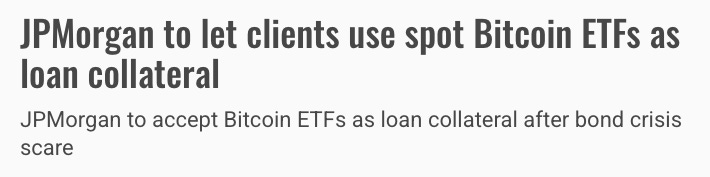
It’s always good to see your thesis play out. But, given where we are in the global economy, I do think the timing of this news is peculiar because it marks a historic inflection point in the financial system's evolution, representing the first major institutional recognition of Bitcoin as "safe collateral" comparable to traditional assets like government bonds and real estate. This is the beginning of fundamental restructuring of the collateral hierarchy that has underpinned credit markets for decades, with profound implications for government financing, monetary policy effectiveness, and the broader economy.
However, a bit of background about this strategic pivot by JP Morgan before we dive deep. Below is an incomplete, but sufficient, chronology of the view of Jamie Dimon, CEO of JP Morgan Chase, on Bitcoin. I welcome you to join me for a chuckle at the expense of big banks in general, and Jamie, in particular.
September 2017: “If a JPMorgan trader began trading in bitcoin, I’d fire them in a second. For two reasons: It’s against our rules, and they’re stupid... It’s a fraud and worse than tulip bulbs.”
September 2022: “I’m a major skeptic on crypto tokens, which you call currency, like Bitcoin. They are decentralized Ponzi schemes.”
January 2024: “Bitcoin does nothing. I call it the pet rock.”
January 2025: “Sooner or later we will have some kind of digital currency. I am not against cryptocurrencies. Bitcoin itself has no intrinsic value. It is heavily used by sex traffickers, money launderers, ransomware. It’s just that I don’t like Bitcoin. I applaud your ability to want to buy or sell it. Just like I think you have the right to smoke, but I don’t think you should smoke!”
May 2025: “I am not a fan [of Bitcoin]... Our clients are adults. They disagree. That’s what makes markets. So, if they want to have access to buy yourself Bitcoin, we can’t custody it, but we can give them legitimate, as clean as possible, access.”
And now, he will accept Bitcoin as collateral. It reminds me of this scene from the movie The Big Short about the 2008 Global Financial Crisis:

Even as the housing market was crashing, Michael Bury’s credit default swaps remained undervalued up until Goldman Sachs acquired a net short position themselves, and it was in their interest to price the CDSs accurately. Remember, there have been reports that JP Morgan has been buying Bitcoin through their European offices for years now while publicly calling it a scam and a Ponzi scheme. It’s now in their interest to mainstream Bitcoin. That’s why this announcement matters. The context is everything.
And they are going all in. The bank will now include clients' crypto holdings in net worth calculations alongside traditional assets like stocks, real estate, and art, fundamentally altering how wealth is assessed for borrowing purposes. This policy extends globally across JP Morgan's wealth management clients, from retail customers to high-net-worth individuals, establishing a precedent that other major financial institutions are likely to follow.
I believe this will reset the monetary premia for assets globally. Monetary premia is a wonkish concept and refers to the portion of an asset's value derived from its function as a store of value rather than its utility. Gold has historically been a great example of this, with approximately 90% of its value attributed to monetary premium rather than industrial use. But in a world of monetary debasement, a number of other assets have also captured some form of monetary premia.
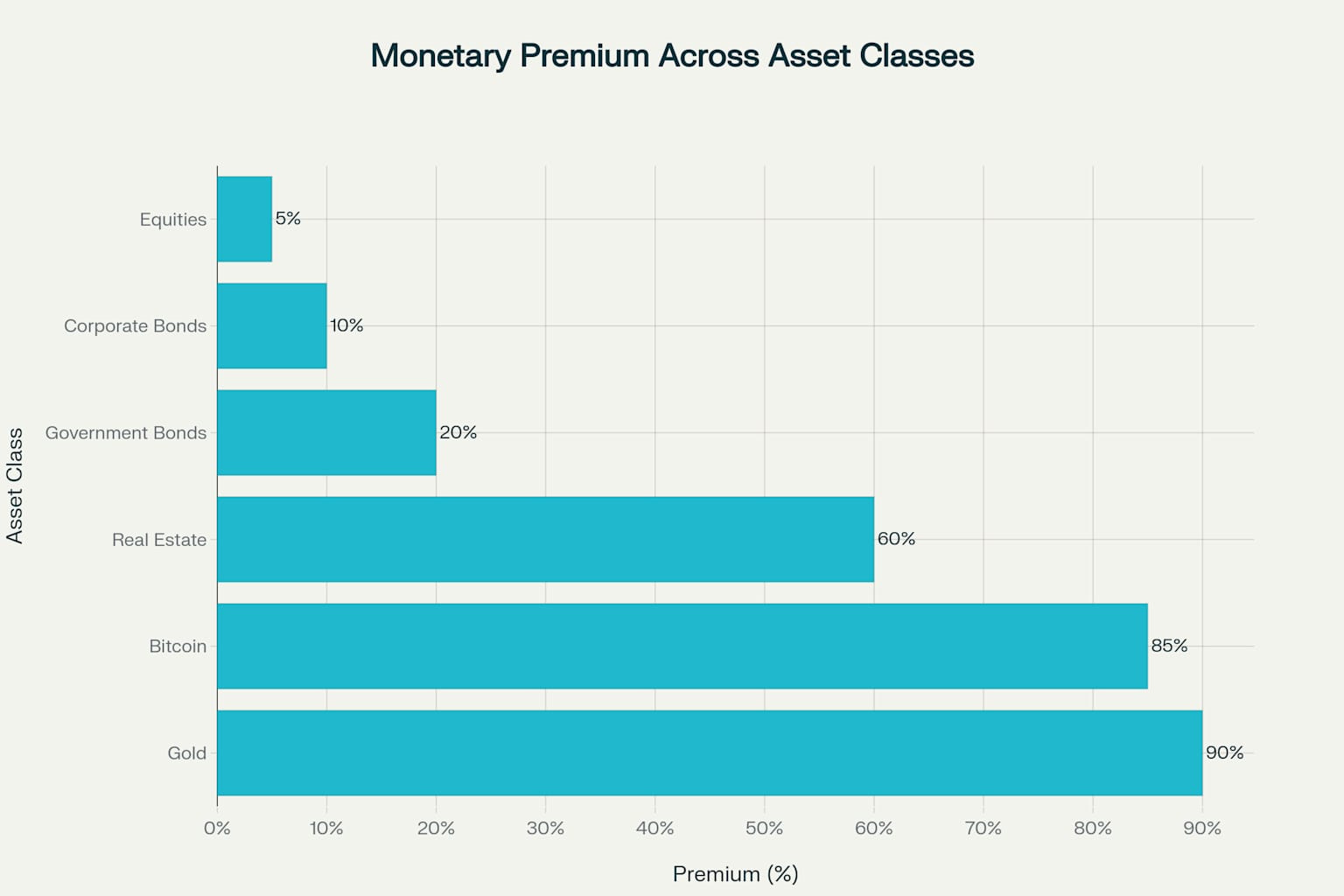
As Bitcoin goes up in value, outside of increased demand for store of value, the rising valuation signals a shift in preferences for what assets investors desire. This is the extraction of monetary premia by Bitcoin from other assets. As you might reason from the chart above, this can have serious consequences for real estate. Here’s another excerpt from my September piece:
Traditional collateral, like real estate, is largely opaque. So all forms of credit built on top of it carry the risk of the presumed value of the collateral not being realized. The opaqueness of the collateral was one of the central themes in 2008 and why MBSs became increasingly risky to hold. Free markets work because they continuously help remove information asymmetries. When you add opaque collateral that leads credit creation which underpins global economic growth, you add structural information asymmetries globally. These information asymmetries can play out over decades, but they do what information asymmetries have always done: benefit the few at the expense of many. The nature of the collateral is quite simply the biggest economic inefficiency globally and resolving this inefficiency is critical in expanding the economic frontier.
But it’s not just housing. Bond markets, like all markets, depend on the marginal buyer. Increased short time preference among investors in light of excessive debt and fears of inflation or default will reduce the monetary premia of bonds causing yields to stay elevated. The acceptance of Bitcoin as collateral will also fundamentally alter government bond market dynamics by reducing demand for sovereign debt as collateral. Government bonds have historically served as the premier collateral asset, accounting for over 90% of European repo market collateral and approximately two-thirds of the US repo market. As financial institutions increasingly accept Bitcoin as collateral, the traditional "convenience yield" that investors have been willing to forgo to hold safe and liquid government bonds may decline further. Treasury data indicates that the convenience yield has already fallen from around 125 basis points pre-pandemic to approximately 70 basis points, contributing to rising yields.
Bitcoin's emergence as preferred collateral will also undermine traditional monetary policy transmission mechanisms that rely heavily on government bond markets. Central banks have historically used quantitative easing and yield curve control by purchasing government bonds, but the availability of alternative collateral reduces the effectiveness of these tools. This dynamic will only further the ongoing "fiscal dominance," where persistently high deficits and debt levels render monetary policy ineffective at controlling inflation. In such scenarios, higher interest rates intended to combat inflation will actually exacerbate the problem by increasing government debt service costs and requiring further deficit spending, not unlike the last 2-3 years.
Bitcoin, then, becomes an existential threat to the status quo. The existing credit market infrastructure, built around traditional collateral assets and their associated intermediation chains, faces disruption from Bitcoin's unique properties. Current collateral flows rely heavily on bank-affiliated broker-dealers acting as intermediaries in bilateral repos, triparty repos, and cleared transactions through central counterparties. These systems involve complex transformations—credit, liquidity, and risk—that enable less creditworthy participants to access funding and less liquid assets to be structured into liquid instruments. However, Bitcoin's programmable nature and instant settlement capabilities threaten to eliminate many of these intermediation layers, reducing costs but also destroying established business models. The velocity of collateral—how frequently it can be reused across different transactions—increases dramatically with Bitcoin due to its 24/7 availability and instant settlement, potentially amplifying leverage in the system while reducing the need for traditional collateral intermediaries.
Systemic Risks
As much of a Bitcoiner as I am, I do not relish seeing some of these scenarios play out. Firstly, because this mainstreaming of Bitcoin does not guarantee a world of responsible leverage. While new financing companies like Strike have committed to abstaining from rehypothecation of collateral, the same cannot be said of JP Morgan Chase. Bitcoin's properties could either exacerbate these risks by enabling more rapid collateral cycling or mitigate them by providing more transparent, programmable constraints on reuse. I am yet to see any evidence from US legislators to assume this question is even on the periphery of their thinking.
Secondly, the emergence of Bitcoin as widely accepted collateral will naturally impose new economic limits on government action by reducing their ability to suppress borrowing costs through traditional monetary policy tools. In the long run, I believe, this will be a welcome change. However, in the short run, as alternative assets gain acceptance in collateral markets, the market discipline could force governments to significantly alter their welfare states at great costs to their citizens.
Third, Bitcoin’s collateralization will also initiate new cycles of Schumpeterian creative destruction. The destruction of traditional collateral intermediation could reduce financing costs for businesses while improving capital allocation efficiency. However, the transition period may involve significant disruption as existing credit relationships and risk management systems require restructuring. In corporate credit transformation, alternative or new providers of credit can improve credit availability and foster economic growth, but they can also introduce new risks through less regulated structures and potential standard deterioration.
How do we create safeguards?
First, consider personal exposure to Bitcoin. This isn’t financial advice, but a simple observation: if even a fraction of people had thoughtfully allocated a small portion to Bitcoin, many would feel less anxious about their financial future as the traditional system shows increasing signs of strain.
Second, it’s time for governments to move beyond resistance and begin to embrace the innovation that crypto represents. Digital assets are not just speculative tools—they’re a leap forward in how humanity can measure, store, and transfer value. With global debt-to-GDP ratios at record highs and demographic headwinds intensifying, clinging to old models and suppressing digital growth will only delay the inevitable reckoning. Policymakers need to focus on fostering clarity and fair regulation, instead of simply seeking new ways to refinance government debt, like with the stablecoin bill, which is likely to have some adverse outcomes. The real opportunity lies in enabling genuine economic growth, not just propping up the status quo.
Third, it’s crucial to recognize that physical growth alone cannot solve today’s debt crisis. The world’s population is aging and shrinking in many regions, and productivity gains are no longer sufficient to offset the scale of existing deficits and interest obligations. Each new dollar of debt delivers less and less real economic output, and the sheer magnitude of debt now requires growth rates that are simply unattainable through traditional means. The math no longer works: we cannot simply “grow our way out” as we did in the past.
Crypto is not going away. Regulatory inertia or hostility will not stop its development; it will only drive innovation elsewhere and leave citizens more exposed to the consequences of monetary mismanagement. The longer governments delay, the greater the cost for ordinary people—those who have already borne the brunt of decades of financialization and now face the risk of further erosion in their economic security. The time to act is now, before the consequences of inaction become irreversible.