
Rules and Exceptions

"It's the curse of old men to realize that in the end, we control nothing."—Saul Berenson, Homeland
As Donald Trump continues to reshape America's trade relationships through an unprecedented series of bilateral agreements, a clear template has emerged that signals a fundamental restructuring of the global economic system. The seemingly chaotic array of tariffs, investment commitments, and energy purchases masks a coherent strategy designed to extract maximum value from trading partners while establishing new rules of international engagement that prioritize American interests above all else. These deals, far from representing traditional trade liberalization, constitute a form of economic coercion that has divided the world into compliant partners and defiant exceptions, with profound implications for global prosperity and stability.
The current wave of trade agreements represents more than tactical negotiation—it embodies a systematic effort to impose what might be called "soft capital controls" on the global economy. I covered last week why capital controls are important in achieving balanced trade. You can read the whole piece here, but here’s a snippet
“With contemporary levels of capital mobility, production naturally gravitates toward locations with the lowest absolute costs rather than following comparative advantage patterns. The result, as Ricardo predicted, benefits capital owners and consumers but can harm workers in higher-cost locations. When capital can move freely between countries, the theory that trade will benefit all participants no longer holds. Instead, trade becomes a potentially zero-sum competition where gains for some groups come at the expense of others.”
Through a combination of standardized tariff regimes, mandatory investment commitments, and outsized energy purchase obligations, the United States is effectively compelling foreign nations to finance American economic growth while accepting subordinate positions in the new economic hierarchy. Yet this strategy contains inherent contradictions and vulnerabilities that may ultimately undermine both American objectives and global economic stability.
The Rules
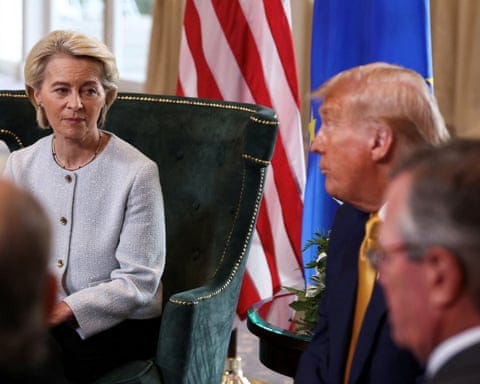
Trump's approach to trade negotiations has crystallized around three core principles that have become standard features across virtually every agreement. First, tariffs are no longer exceptional measures but permanent fixtures of the new trade architecture. The baseline tariff rate of 15% has become the standard offering for compliant nations, with rates escalating to 25% or higher for countries that resist American demands or maintain relationships deemed problematic by Washington. This represents a dramatic shift from the pre-2025 average of 2.5% to current levels approaching 18%—the highest since the 1930s. The European Union's recent capitulation exemplifies this new reality. After facing threats of 30% tariffs, EU negotiators accepted a 15% baseline rate on most goods, coupled with commitments to invest $600 billion in American infrastructure and purchase $750 billion in U.S. energy over three years. Similarly, Japan and South Korea have agreed to 15% tariffs alongside investment commitments of $550 billion and $350 billion, respectively. These figures, while politically impressive, are widely regarded as aspirational rather than enforceable, serving more as symbols of submission than realistic market projections.
Second, the pivot from portfolio investment to foreign direct investment (FDI) represents a fundamental reorientation of capital flows. Unlike the passive financial investments that dominated previous decades, Trump's deals demand tangible, controllable investment in American manufacturing, infrastructure, and technology. This shift serves multiple purposes: it creates sticky, harder-to-withdraw capital commitments; it provides the administration with direct oversight over how foreign funds are deployed; and it supports domestic employment and industrial capacity in politically sensitive regions. The administration's Investment Accelerator, established to "facilitate and accelerate investments above $1 billion," exemplifies this approach. Rather than allowing market forces to determine investment allocation, foreign partners must direct their capital toward projects explicitly approved by Washington. This mechanism transforms international investment from a market-driven process into a tool of American industrial policy.
Third, American debt management has become inextricably linked to trade policy. My analyses in the aftermath of the Liberation Day tariffs highlighted how Trump’s economic shift was mainly about debt. However, I did not foresee the extent of control the US will seek on foreign capital. Make no mistakes, these government-directed investments are effectively a way to finance US growth without debt issuance or in some cases, the direction from Washington could simply be about buying treasury securities. And if Trump does that, the United States will have effectively outsourced its funding needs to foreign governments while maintaining control over the terms and conditions of such purchases. The mechanics of this system also rely on the emergence of stablecoins and new financial instruments that create captive demand for short-term Treasury securities. It will be naive not to consider these new instruments of government financing in the larger economic imperatives of debt and growth. With stablecoin issuers now holding over $200 billion in U.S. debt and projections suggesting this could reach $2 trillion by 2028, the administration has found a mechanism to ensure consistent demand for American debt instruments regardless of traditional foreign investor appetite.
The Exceptions
If these three principles underlie the Trump Administration’s thinking, it is reasonable to imagine that not every nation will succumb to American pressure, and the pattern of exceptions can reveal the limits of U.S. economic leverage. Middle Eastern energy producers—Saudi Arabia, the UAE, and Qatar—have negotiated more balanced arrangements that reflect their strategic importance and financial resources. These nations bring substantial capital, critical energy supplies, and regional influence to the relationship, enabling them to secure technology transfers, security guarantees, and market access on more equitable terms. The Middle Eastern exception demonstrates that Trump's system works primarily against economically dependent partners. Countries with significant leverage—whether through resource control, market size, or strategic alternatives—can resist the most onerous demands and achieve genuine reciprocity in their arrangements.
China presents the most complex exception, neither fully compliant nor entirely resistant. The ongoing negotiations reflect the structural reality that the world's two largest economies cannot easily decouple despite political tensions. Current agreements have reduced tariffs from peak levels of 145% to 30%, with regular extensions suggesting both sides recognize the mutual costs of complete economic separation. In my previous pieces, I have highlighted this co-dependence where America needs to onshore a share of Chinese manufacturing while China needs another Shanghai accord to jump-start domestic consumption that is threatening to devolve into a deflationary spiral. The Chinese exception reveals the tension between Trump's desire for economic dominance and the practical limits of American leverage. China's control over supply chains of key minerals, manufacturing capacity, and alternative partnerships provides sufficient resilience to withstand prolonged trade pressure, forcing Washington into genuine negotiation rather than dictated terms.
India and Russia, outside of China, represent the most significant challenges to this new American economic framework, albeit for different reasons. India's rejection of a 15% tariff deal in favor of accepting 25% tariffs plus additional penalties demonstrates a calculated decision that independent economic policy outweighs the benefits of American accommodation. Despite claims from Trump that negotiations are still ongoing, the fact that Trump had to resort to threats on X, compounded by a lack of response from the Indian side, suggests a striking confidence that the Indian government has in its economy. With a rapidly growing domestic market, relatively low debt levels, and diverse trading relationships, India possesses the economic flexibility to absorb American pressure while pursuing alternative opportunities.
Russia's position, while constrained by sanctions, illustrates how resource-rich nations can maintain economic independence through alternative trading relationships. The failure of 85% of the world's countries to fully implement Biden-era sanctions suggests that Trump's pressure tactics may be similarly ineffective against nations with critical resources and alternative markets. In general, I see these threats of sanctions as yet another effort by Trump to end the Ukraine war. But Biden invited this war, and Trump has to bear the cross for it.
These exceptions, along with the forced change in the behavior of compliant partners, have the potential to create what might be termed "air pockets of economic growth"—regions where the American extraction of resources leaves opportunities for non-aligned nations to capture market share, attract investment, and build alternative economic relationships, both as first-order and second-order effects. India's position allows it to benefit from Europe and Japan's energy purchase commitments by accessing cheaper supplies in global markets while avoiding the costly commitments imposed on American allies. Geo-politically, as the US and China deal with heightened need for domestic growth, countries like India and Russia will find opportunities to further expand their ever-growing influence in the global south.
The Burden
The ambitious scale and artificial nature of many trade deal commitments virtually guarantee that market forces will identify and exploit resulting inefficiencies. European energy commitments provide the clearest example of how unrealistic political agreements create arbitrage opportunities. The EU's pledge to purchase $250 billion annually in American energy—roughly three times current import levels—exceeds both American export capacity and European import requirements. This mismatch suggests that European entities, compelled to fulfill political commitments, may find themselves purchasing American energy only to resell it in global markets at a loss. Such arrangements effectively transform European governments and companies into subsidizers of American energy producers while creating downward pressure on global energy prices that benefits non-aligned consumers like India and China. Or the pledges could simply not be honored. These deals are yet to be ratified by the Congress and parliaments of the partner countries.
At the same time, Bessent is likely to continue to grapple with the mess that Yellen left behind for him, and the latest QRA does not offer any hope of that mess going away anytime soon. The concentration of short-term debt issuance creates additional vulnerabilities in the American financial system. While stablecoin demand and bank preferences may currently absorb increased Treasury bill issuance, this strategy concentrates refinancing risk in shorter time horizons. Unlike long-term bonds that provide funding stability, short-term instruments must be continuously refinanced, potentially exposing the Treasury to sudden shifts in market conditions or foreign partner compliance. The regulatory framework for stablecoins, while providing new sources of Treasury demand, also introduces cryptocurrency market volatility into core government funding mechanisms. Should confidence in stablecoins erode or regulatory frameworks change, the Treasury could face sudden demand shortfalls requiring alternative funding sources or higher interest rates.
The Financialization of Everything

This past week, the U.S. Senate passed the Guiding and Establishing National Innovation for U.S. Stablecoins (GENIUS) Act, a landmark bill that establishes the first comprehensive federal framework for stablecoins—digital tokens designed to maintain a fixed value, typically pegged 1:1 to the U.S. dollar. Unlike central bank digital currencies (CBDCs), w…
Exchange rate pressures present another source of potential instability. My base case has been that the dollar is headed lower, in the absence of any major credit event. That said, if all elements of these trade deals were to be implemented, it could impose downward pressures on other currencies, resulting in debt/currency crises discussed above.
The Dividend
Perhaps counterintuitively, the coercive nature of American trade policy may accelerate global economic fragmentation in ways that ultimately benefit non-aligned nations. One of the flip sides of promoting stablecoins is that they encourage greater crypto adoption, and while that may not be a direct threat to the dollar, the rise of alternative payment systems makes currency paraphernalia of several fragile countries wobbly. Historically, nations have resorted to capital controls to deal with such volatility and in doing so increase the fragmentation dividend of global economic growth, wherein more economically independent countries could benefit from globally concentrated growth.
Technology transfer restrictions and investment controls are similarly driving innovation in non-American systems. As the United States becomes more selective about technology sharing and foreign investment, excluded nations are investing heavily in indigenous capabilities and alternative partnerships. This dynamic may accelerate the emergence of competing technological ecosystems that reduce global dependence on American innovation. The global south's rising importance reflects these shifting dynamics. As traditional American allies face increased financial pressures and investment obligations, developing nations with lower debt burdens and fewer constraints may become more attractive partners for trade and investment. Countries like India, Indonesia, and Brazil are positioning themselves to capture economic opportunities created by the fragmentation of traditional Western-centered trade relationships. We have already seen India onboard poor countries on its Aadhar digital identity ecosystem, and while Indian tech might not be a direct competitor to American tech, the larger framework of increased fragmentation leading to concentrated growth stands.
All of this brings into question the sustainability of Trump's trade regime, which depends critically on the continued economic health of compliant partners, whether that’s recognized by the Trump administration or not. European and Japanese debt dynamics present particular concern, as energy purchase commitments and investment obligations add to already substantial fiscal pressures. Should European nations face sovereign debt crises or currency instability, their ability to fulfill American trade commitments would diminish precisely when such support might be most needed. The combination of higher import costs from American tariffs, mandatory energy purchases at above-market rates, and currency depreciation could create sustained inflationary spirals that force domestic policy responses incompatible with American trade obligations.
The Equilibrium
So while these trade deals struck by the Trump administration represent an ambitious attempt to restructure global economic relationships around American advantage, they contain inherent contradictions that make their long-term success tricky, to say the least. By treating trade policy as a zero-sum competition rather than a mechanism for mutual benefit, these agreements have created artificial constraints and obligations that market forces will inevitably test. It’s not a matter of justification—it’s hard to argue that America has not subsidized the growth and debt of these countries. However, markets exploit opportunities, and as the various elements of these deals begin implementation, markets will identify the inefficiencies and imbalances they create. European and Japanese companies facing losses on mandated energy purchases may find ways to minimize compliance, or pass costs to consumers, or ask governments for industrial subsidies, potentially triggering a political backlash. Perhaps more significantly, the exclusion of major economies like India and Russia from the American system can create alternative centers of economic gravity that could eventually reward the economic boldness of these countries rather than punish geo-political obstinacy. India's willingness to accept higher tariffs rather than subordinate its economic sovereignty suggests that the costs of American pressure may be becoming manageable for nations with sufficient scale and alternative partnerships.
The ultimate test of Trump's trade strategy will come not in the signing ceremonies and headline commitments, but in the mundane realities of implementation. Can European governments actually compel their companies to purchase three times their current energy imports from America? Will Japanese investors genuinely deploy $550 billion in American projects selected by Washington? Can the Treasury continue refinancing ever-larger amounts of short-term debt through increasingly complex financial instruments? The early evidence suggests that while Trump's approach has succeeded in extracting political concessions and symbolic commitments, the underlying economic dynamics favor fragmentation over consolidation. There is no changing Trump’s mind, but America will do well to remember that weak allies make for a weak alliance.