
Return The Toys
Centralization of power must lead to decentralization

Imagine a household with kids home for their summer break. The kids are creating a ruckus playing with the toys and the mother walks in. Apalled by the disheveled state of the room, the mother asks the kids to leave and behave themselves. But now she has got a mess to deal with and the first thing she has to do is to collect all the toys. Once she is done, she has a choice to make. She can return the toys to the kids (either right away or in a day or two) or she can withhold them for a long time until she is sure that the kids have learnt their lessons. However, there is a third, scantily believable, option—She could hold the toys for herself and play with them while the kids do their homework (assuming schools still assign homework). Obviously, that’s a crazy idea. If a mother abdicated her duties and instead played with toys meant for kids, the whole household will fall apart. That’s how I look at the world right now—a ton of consolidation and concentration by the states with little to no visibility on whether the toys will be returned to the kids.
Let’s begin with America. Not that the normies paid attention, but this past week U.S. government announced a procurement of 10% stake in Intel, in return for existing grants as part of the CHIPS act and other DoD contracts. Libertarians, a small political minority, were expectedly miffed and have since been ruining the descent of American democracy into socialism. But then again, if you’ve been paying attention, you can find similar rhetoric across the board of politics—It’s either Trump destroying social security and speeding America’s descent into a plutocracy, or unleashing fascism by deploying national guard in the nation’s capital, or taking the next step in a slow moving dictatorship by withholding funding from universities.
A few months back I wrote a piece on the realignment that is beginning in our society that sought to explain how this realignment is unavoidable and how everyone will hate it. Here’s how I ended it:
“As I’ve said before, the realignment we’re living through isn’t just a correction—it’s a reckoning with a decade-plus of economic illusions built on debt, zero rates, and misspent government largesse. The charts tell the story: a workforce sidelined since 2008, GDP growth that never regained its stride, and a housing market that’s soared beyond reach, all propped up by a system that mistook spending for solutions. As inflation and rising rates peel back the mirage, we’re left with a stark reality—stagnation, inequality, and fragility across markets from homes to pensions. This shift won’t be gentle, and it won’t spare anyone clinging to the 2010s’ promises. But in its wake lies a chance to rebuild on firmer ground, if we can face the limits we’ve ignored for too long.”

When big changes are afoot, it’s reasonable to be cautious. But it is worth remembering, at times like these, that most people are risk averse and as such do overweight their fears and underweight their hopes. I don’t think I am mistaken when I say that anyone with some life experience will tell you how hard it is to fight for hope compared to how easy it is to give into the fears. I look at the reaction to the Intel deal, or any of the other myriad issues, and can’t help but wonder if it is simply an expression of our collective fears. Screwed over multiple times by all kinds of promises, it is easy to look at what Trump is doing, as yet another power grab in a long series of power grabs with differing outcomes and one constant—people with less power than before.
I share these fears but when everyone from socialists to libertarians turn into the same fears, market principles dictate that we might all be a little too bearish. What if Trump is simply collecting the toys? No one can argue that the system that Trump acquired, especially in Trump 2.0 after the disaster of a Biden Presidency, was not in need for chemotherapy. And chemotherapy is never fun. Part of making a dysfunctional democracy work for the people again is to centralize power to lay the groundwork for a new system that works. It’s always a slippery slope—democracy itself is one. Which is why, as I described in my piece on American Etatism, what we are seeing is the emergence of a zeitgeist “not from ideological choice but from the accumulated weight of crisis responses and the opportunities they created”. The question in my mind is not whether Trump will be the last President, but whether he will return the toys to the kids.
So I am a little relieved to note that the US government will not have an active ownership in Intel, i.e., the government will hold no Intel board seats or direct governance/information rights. That’s a good start. I will hope Trump will lay down more such guardrails, especially as the sovereign wealth fund takes shape. For universities, I would love to see his administration make the university grant making process more democratic, public, and competitive. Trump wants voter IDs and is the first crypto president. How about testing a national voter id system by having university researchers submit proposals for grants and have American people vote on them? That instills democratic values with low risk, aligns university research with the interests of the people, and makes higher education more meritocratic as it incentivizes good research and not brand value. That, for me, will be a wholesome example of giving the toys back.
I see signs of the toys being returned in the rest of the world too. Take India, for example. As India grapples with an increasingly hostile Trump administration, it is being forced into new geopolitical relationships, including a historically strenuous ties with it’s eastern neighbour China. But it was interesting to note that the Modi administration also announced wholesale changes to its Goods and Services Tax (GST) regime to help Indian economy absorb the impact of Trump tariffs. The new GST rates are now just two categories of 5% and 18%, instead of four; and the top rate of 28% is now just 18%. That’s less government and more free markets. That’s Modi returning the toys to the kids. Only a little, but this game is played on the margins and economic priorities and choices become a lot clearer when you pay attention to the margins. It also aligns with my provocatively titled piece, Free Market Tariffs, where I argued that “policies designed to raise prices toward their natural market level—such as tariffs that offset artificial subsidies—could actually move the global trading system closer to genuine market efficiency rather than further from it.”
As Trump seizes resources from the rest of the world, he is setting up a race for increasingly scarce capital. That makes returns on capital more important than ever and forces governments to loosen their grip on the economy and let the free markets breathe. The only way for the rest of the world to compete with America is to outdo America in their respect for capital for as the good old saying goes, “Capital goes where it’s respected the most”. As over-regulated America is, the rest of the world is in a far worse shape. So this transformation that Trump is undertaking, as I have highlighted a number of times, is about the global economy and not simply American supremacy. It also aligns well with my long held belief that an America that works for Americans is an America that works for the rest of the world. It is not a surprise to me that the time in which American soft power has seen it’s worst decline has coincided with the time in which American government has been woefully incompetent in delivering prosperity for it’s people. So, despite the pain that Trump is inflicting on the rest of the world, it’s a pain that eventually forces the governments to back off from the free markets as they search for a solution to protect their own interests of power and influence. Equilibrium is a beautiful thing, but like all beautiful things, it makes you wait.
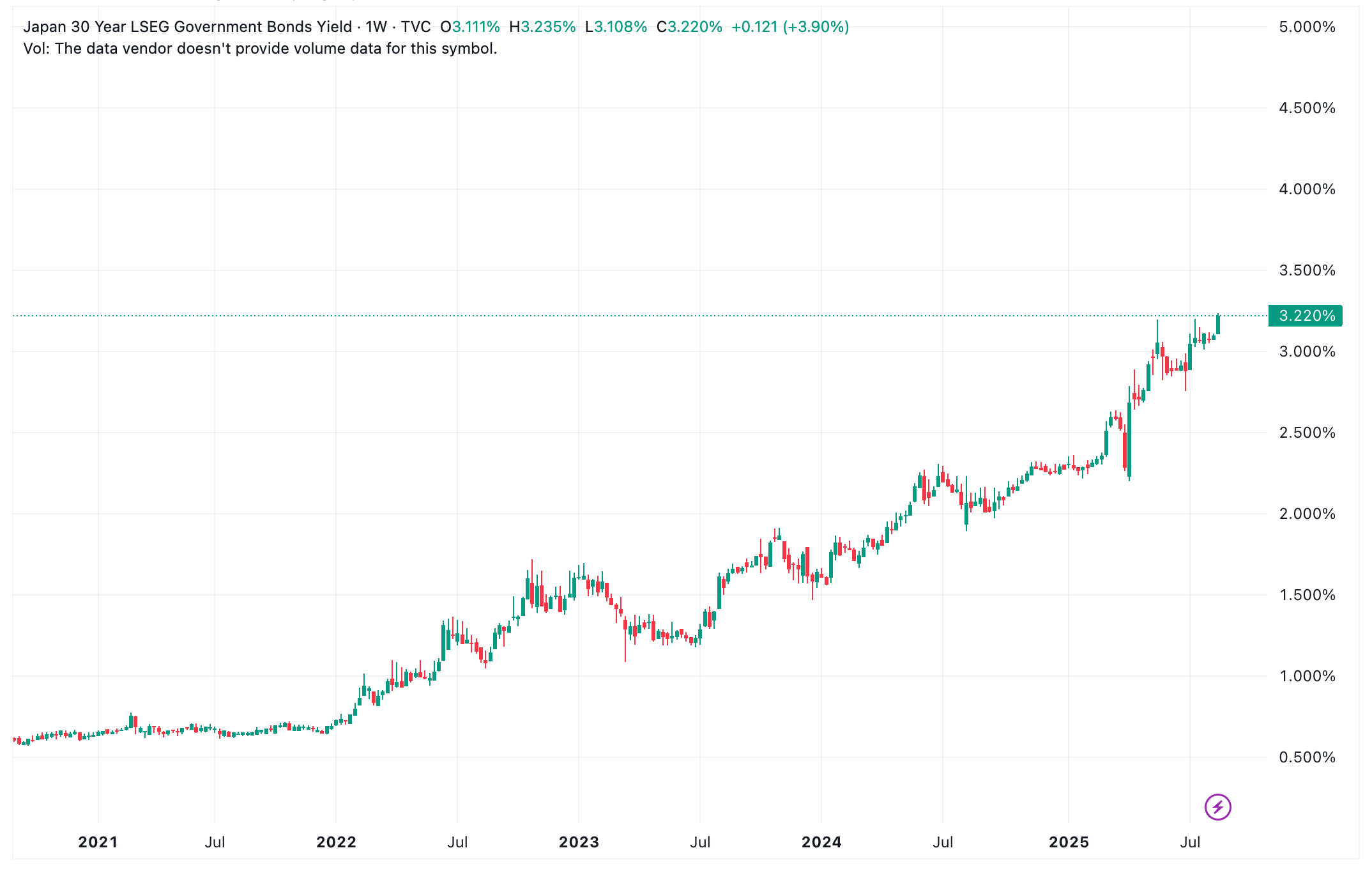
Japan is another good example. Just look at the 30Y yield on the JGBs. In years gone by, you’d have seen an intervention from the BoJ a long time back. But not now. The long end has been rising for three years now and it shows no signs of breaking its upward trajectory. When the system starts breaking, you see the clearest signal in the financial markets. Japan is out of options and as such cannot prevent the free markets from pricing its bonds accurately.
Obviously, less stronger economies, have reacted even before Japan. Argentina is a good example. In late 2024 and into 2025, Argentina began dismantling a number of foreign exchange controls and capital restrictions implemented during previous crisis periods. The government launched an amnesty program that drew more than $20 billion in undeclared assets back into the financial system, significantly boosting liquidity and reducing risk premiums on Argentine bonds. The authorities are also expected to lift further FX restrictions and trade controls in the second half of 2025, which would normalize export/import flows and reduce tariffs in key sectors—critical steps to attract foreign capital and allow proper pricing of assets.
Canada, my adopted home for the last one year, also has to cave to the free markets despite all of its socialist proclivities. In June 2025, the Canadian government passed the One Canadian Economy Act, eliminating all remaining federal barriers to internal trade and labor mobility. This move opens procurement, transportation, and other previously protected sectors to competitive private enterprise across provinces. Provinces and territories are also committed to reviewing and removing their own exceptions under the Canadian Free Trade Agreement, accelerating mutual recognition for goods and services and making labor mobility easier.
You can spot these trends everywhere. That said, I don’t mean to suggest these trends will be consistent around the world. Free markets work because they identify winners from losers in the most efficient way. But there are always losers to help us understand the policies that don’t work. So of course, you’ll see a Mamdani or Starmer pop up from time to time, but the message from the markets is clear—the state is at the limits of it’s capacity and the likes of Mamdani and Starmer will fail miserably, as is obvious from the recent British experience. Trump, on the other hand, is innovating at the margins of this capacity through Etatism. And it is Etatism, and not Socialism or Fascism. Words matter. By capturing equity in the most successful companies, Trump is firming up the asset side of the US balance sheet. That makes debt more financeable which is the top priority and the outcome of the aforementioned “accumulated weight of crisis responses”. Are there opportunities to abuse this new system? Most certainly. But any new system is vulnerable to abuses. What matters is how this new system matures. Trump is still some way from finishing setting this system up and I would reserve judgment until he finishes. But the kids need their toys, Mr. Trump. You should not forget that as you continue to clean up the mess.