
Macro Sparknotes: MS1

I am experimenting with a new series of regular articles - Macro Sparknotes. I willcapture the most interesting stories from the macro world and provide my quick thoughts. The regular deep dives will continue like before but this is simply my way of keeping track. Hope you enjoy it and if you like, hit subscribe. It helps me reach a larger audience.
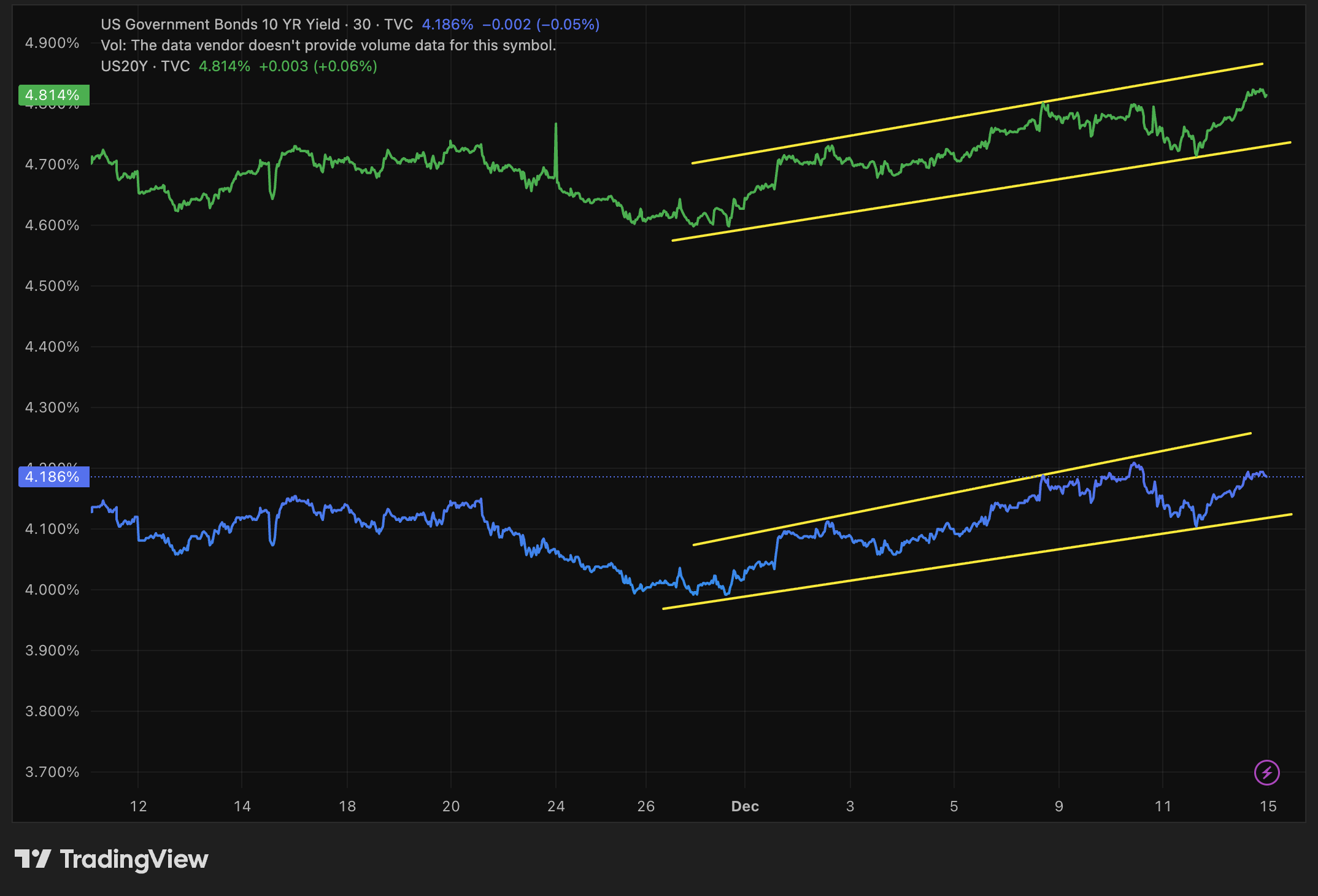
Firstly, we have to discuss the Federal Reserve. The Fed’s decision to cut rates again and to begin buying around $40 billion a month in Treasury bills as “reserve management” is a clear sign that something is not right in the credit markets. The Fed went from announcing end of QT to printing money, whether or not you call it QE is inconsequential. Publicly this is framed as a technical step to stabilise money markets after repeated strains in short‑term funding. The issues, if driven by the most likely suspect in private credit, are probably more than just short-term in nature. Could this be the first step in a de facto yield‑curve control-lite regime in an election‑adjacent period? Because the Fed is putting a floor under liquidity precisely as equity volatility rises and an AI‑led equity bubble shows signs of stress, while long yields have started to creep higher despite rate cuts. The legacy media is still treating this as a minor plumbing operation, while in practice it signals that the U.S. cannot tolerate a disorderly bond sell‑off given the fiscal trajectory and upcoming refinancing wall; that makes “risk‑free” dollar assets increasingly policy‑dependent rather than market‑priced. For investors, the tell is a combination of falling front‑end yields with sticky or rising term premia and strong issuance forecasts being revised down (with greater Treasury issuance on the short end) as the central bank implicitly shoulders more of the curve by buying the short end. Yeah, not QE.
In Japan, 10‑year JGB yields have pushed to their highest levels since 2007 ahead of the Bank of Japan’s December meeting, yet officials maintain a high bar to conduct emergency bond‑buying operations. At the same time, the Ministry of Finance continues to float the possibility of currency intervention as the yen trades weak, even though the last actual FX intervention was in mid‑2024 and involved sizeable spending to support the currency. The mainstream narrative focuses on a cautious, gradual exit from ultra‑easy policy, with some expectation of a rate hike to 0.75 percent as the authorities are “monitoring” rapid moves in both yields and FX. A more cynical interpretation is that Tokyo is trying to engineer a controlled steepening of the curve to help banks and insurers and to re‑internalise savings, while preserving a structurally weak yen to support Japan Inc.’s external competitiveness and foreign earnings translation. Verbal FX threats, rather than actual intervention, buy time and deter speculative one‑way positioning without sacrificing the macro advantage of a cheap currency. The asymmetry here is between domestic messaging—which emphasises vigilance on volatility—and the functional policy mix, which still favours financial repression at home and a competitive export position abroad; for global investors, the risk is a sudden, credibility‑driven policy pivot if yen weakness is perceived as politically toxic, which would mean both JGB and FX volatility repricing at once.
The third thing that caught my attention, as I am sure it did yours, was the widening use of geoeconomic coercion by the U.S., and the way it is now bleeding into emerging‑market currencies and bond markets. U.S. forces have reportedly seized a Venezuelan oil tanker and its cargo, leading to an abrupt halt in tanker movements around Venezuelan waters and a steep drop in that country’s exports. Officially the move is framed in terms of sanctions enforcement and rule‑of‑law, but structurally it reinforces Washington’s capacity to weaponise control over maritime chokepoints and dollar‑denominated trade documentation—sending a clear signal to other sanctioned or “swing” energy suppliers about the costs of non‑alignment. Worth mentioning that in response Iran also seized an oil tanker with 6 million barrels of oil; Europe attacked a ship carrying Russian oil, and in response Russia has since bombed two Turkish ships carrying shipments from Ukraine.
In parallel, India’s rupee has slid to fresh record lows against the dollar amid ongoing trade frictions and portfolio outflows, as earlier U.S. tariff hikes and stalled negotiations undermined export‑oriented sectors and foreign investor confidence. Market coverage tends to attribute rupee weakness to global growth concerns and general risk‑off sentiment, but you have to wonder just how much the U.S. trade policy is contributing to discipline the fastest growing economy in the world while keeping them just dependent enough on dollar funding and U.S. demand to limit their room for geopolitical manoeuvre. New Delhi talks about diversification and “strategic autonomy,” yet the pricing of their currencies and sovereign yields continues to be highly sensitive to Washington’s tariff calendar and sanctions posture rather than to domestic fundamentals alone.
Overlaying all of this is a background of elevated geopolitical risk and persistent conflicts that markets are increasingly treating as noise until they affect energy flows or central‑bank reaction functions. The continuation of Russia’s war in Ukraine, rise in Japan-China tensions, intensifying North Korean brinkmanship, and repeated flare‑ups in the Middle East all sit on risk dashboards but have produced only transient market reactions unless they intersect with oil shipments or trigger safe‑haven demand for gold and Treasuries. It seems that, for now, investors have learned to “look through” geopolitical shocks, which is comforting. However, we have to keep an eye out for the repricing of which conflicts matter, with those that reshape supply chains, energy routing, or tariff structures exerting far more lasting influence on valuations than raw military risk. This habituation to conflict has made markets slow to price non‑linear escalations—such as a move from targeted tanker seizures to broader disruption of key sea lanes, or from tariff skirmishes to full financial decoupling in specific tech sectors.
For positioning, this mix points to a world where policy actions in bond and currency markets are increasingly strategic tools rather than technocratic responses, and where the key edge lies in reading the gap between stated intentions and structural incentives. In practice, signals to track include: whether Fed T‑bill purchases expand beyond “technical” needs; whether Japan tolerates further yen weakness without hard intervention while still capping JGB volatility; whether EM currencies, under trade pressure, weaken independently of commodity terms of trade; and whether energy‑related coercive actions expand from singled‑out states to broader categories of “unreliable” suppliers. Those benefiting are issuers and corporates closest to the centres of monetary and security power, which can externalise volatility and socialise funding costs; those most exposed are peripheral sovereigns and leveraged sectors that must price credit and currency risk in systems where the rulebook is increasingly subordinated to great‑power strategy.
Like this post to let me know you like reading quick macro outtakes.
This is promising, i like it, keep it up!
Thanks. Yeah, I think writing some quick thoughts also keeps me honest in keeping a broad perspective.