
Emerging Equilibria

The announcement of the EU–India free trade agreement has been described, with some justification, as the “mother of all deals.” It links two of the world’s largest democratic markets in a comprehensive pact that slashes tariffs, opens selected services, and embeds cooperation in technology and security. Yet the significance of this agreement lies less in its tariff schedules than in what it reveals about the emerging structure of the international system. It is a deal about goods and services, but it is also a deal about power, about hedging, and about how states now think about order in a world where American dominance is both indispensable and increasingly contested.
For most of the post‑war period, the global economy has operated within what might be called a hegemonic equilibrium. At its core sits the United States, providing a reserve currency, security guarantees, and the most important market for high‑value goods and technology. Participation in this system has brought enormous benefits, but it has also given Washington the ability to unilaterally adjust the terms of access—through tariffs, sanctions, export controls, and financial pressure. In this equilibrium, others adapt around the preferences of the hegemon, sometimes grumbling, sometimes resisting at the margins, but rarely possessing a meaningful outside option. That logic has only become more visible in recent years, as U.S. trade policy has turned more openly transactional and the instruments of economic statecraft have been used with greater frequency.
Running alongside this hegemonic structure, however, a different logic has been taking shape—a competitive and collaborative equilibrium that seeks to preserve maximum option value rather than lock in to a single patron. In this model, states deliberately build overlapping trade, technology and security arrangements with multiple poles. They avoid exclusive commitments, cultivate redundancy in partners, and treat rules not as fixed hierarchies but as a portfolio of regimes they can navigate. The EU–India agreement is a textbook expression of this mindset. Brussels and New Delhi are not trying to exit the American‑centred system: the dollar, NATO and U.S. technology remain central to European and Indian security and prosperity. Instead, they are using each other to diversify their dependencies, reduce their vulnerability to unilateral U.S. decisions, and improve their bargaining position within the larger system.
India is not the owner of this competitive‑collaborative equilibrium, but it is arguably its first serious practitioner and, today, its most experienced system designer. For nearly eight decades, India has insisted on democratic sovereignty under conditions of often unsympathetic great‑power politics. It has risen not as a protégé of the United States but, frequently, in spite of Washington’s preferences. That history matters because it explains both India’s instincts and the appeal of its playbook to others now looking for ways to navigate great‑power rivalry.
The turning point of 1971 remains central to Indian strategic memory. As a humanitarian catastrophe unfolded in East Pakistan, Indira Gandhi encountered a very different Washington from the one that had grudgingly supported India under Lyndon Johnson. Richard Nixon and Henry Kissinger viewed India through the lens of their China opening and Cold War triangulation. They tilted decisively toward Pakistan, downplayed the refugee crisis, and ultimately sent the Seventh Fleet into the Bay of Bengal as a coercive signal. The Soviet Union, in response, deployed its own naval forces and made clear that intervention would carry risks. India proceeded with the war, emerged victorious, and midwifed the birth of Bangladesh. The lessons drawn in New Delhi were not abstract. The United States could not be relied upon in moments of existential crisis. A formal security understanding with Moscow had been necessary, not optional. Non‑alignment would henceforth mean non‑alignment in rhetoric, autonomy in practice, backed by very concrete external balancing.
A generation later, the 1998 nuclear tests reinforced the same instincts under very different conditions. India conducted Pokhran‑II despite clear warnings that it would trigger automatic sanctions and international opprobrium. The sanctions that followed were painful: credits were cut, multilateral lending delayed, technology cooperation frozen. But India did not roll back its programme or fall into line with the Comprehensive Test Ban Treaty on U.S. terms. Over time, economic reforms, domestic resilience and shifting geopolitical priorities in Washington eroded the bite of those measures. From Delhi’s perspective, the deeper message was that national priorities could not be subordinated to the preferences of even the most powerful partner, and that the price of strategic autonomy had to be paid up front in the form of reduced vulnerability to external economic pressure.
These episodes are not history for its own sake; they are the foundation of India’s current doctrine. What used to be called non‑alignment has evolved into the more explicit language of strategic autonomy. India buys advanced fighters from France, missile systems from Russia, drones and co‑developed systems from the United States. It joins the Quad, participates in U.S.‑backed Indo‑Pacific initiatives, signs deep technology and investment agreements with Western partners, and simultaneously maintains a working relationship with Moscow and a complex economic engagement with Beijing. It is integrated into U.S.‑anchored technology ecosystems—what one might call Pax Silica—while refusing any formal alliance. Behind the slogans, the principle is simple: never be structurally dependent on a single power’s goodwill, and always preserve the ability to defend yourself, even against your friends.
Seen through this lens, the EU–India pact becomes part of a much longer Indian story rather than an isolated breakthrough. It is another instrument for operationalising strategic autonomy: a way to open a huge new market for Indian exporters, attract capital and technology, and embed India more deeply into non‑Chinese value chains, all without compromising its freedom of manoeuvre vis‑à‑vis Washington or anyone else. At the same time, it is Europe’s most explicit move yet toward the competitive‑collaborative equilibrium India has long inhabited.
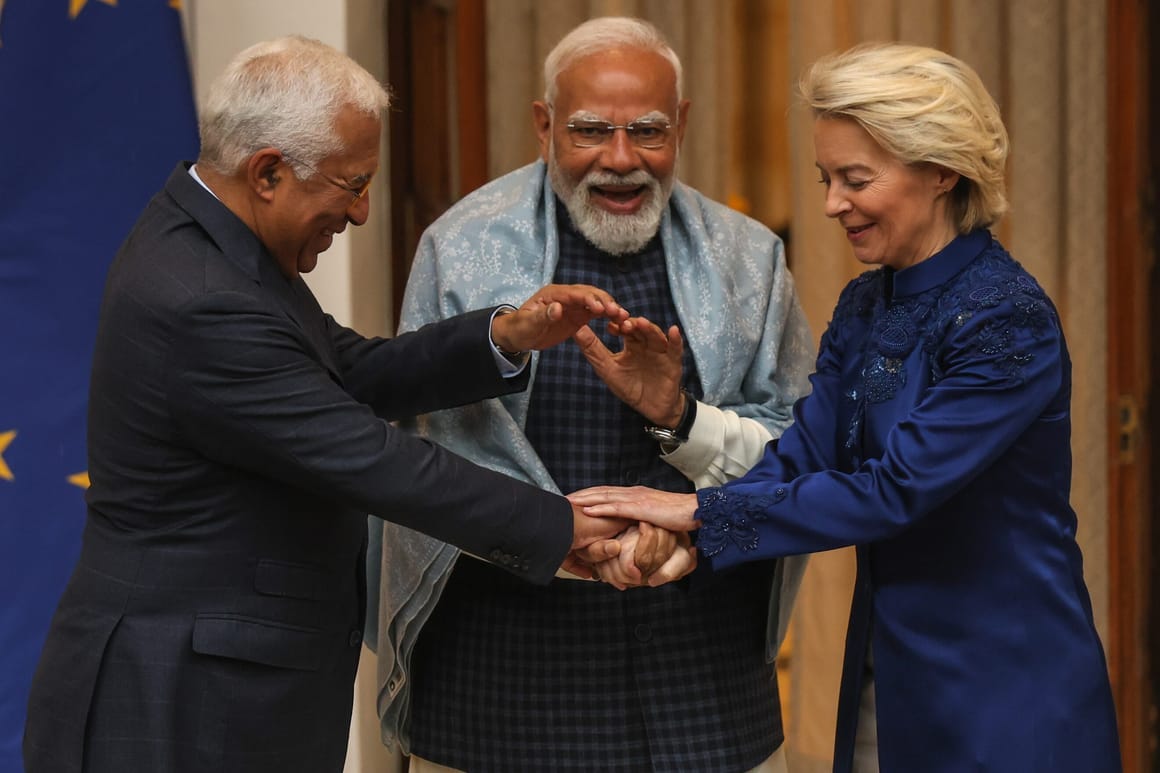
Europe’s motives are not identical to India’s, but they rhyme. The European Union remains anchored in the American equilibrium for its security; NATO and U.S. defence guarantees are irreplaceable in the near term. The dollar system and U.S. financial markets are still central to European capital. Yet European leaders have been repeatedly confronted with the costs of over‑reliance: U.S. sanctions that spill over into European firms, abrupt shifts in trade policy, extraterritorial application of domestic law, and, more recently, the recognition of structural dependence on Chinese manufacturing. Strategic autonomy has entered the European vocabulary as a response, but turning it into practice requires concrete diversification. A large‑scale trade and investment pact with India—alongside agreements with Japan, Korea and others—is Europe’s way of copying a page from India’s own book: build dense horizontal ties first, then negotiate with Washington and Beijing from a stronger outside option.
The result is that what we lazily call “multipolarity” is, in practice, crystallising into two broad equilibria rather than a free‑for‑all of competing orders. On one side is the hegemonic equilibrium, centred on the United States, its currency, its security alliances and its capacity to set and enforce rules. On the other is the competitive‑collaborative equilibrium, in which states—India, increasingly the EU, key Gulf and ASEAN countries—seek to maximise flexibility by constructing a lattice of relationships that prevents any one power from dictating terms. There are many actors, but only a limited number of sustainable ways to organise interdependence under rivalry. Most countries, over time, will be pulled toward one or the other logic, or some hybrid combination. Idiosyncratic models are simply too costly to maintain.
There is an irony here. The demand for a “multipolar world” has often been articulated as a call for greater diversity of models and more space for civilisational or regional difference. In practice, however, the system seems to be settling into two attractors: a hegemonic solution and a competitive‑collaborative solution. The first promises stability and scale, but risks slipping into coercive dominance if left unconstrained. The second promises agency and bargaining power, but depends on constant management of relationships and the willingness to invest heavily in national resilience, especially defence. India’s history—its experience of being pressured and sanctioned yet persisting with its own course—suggests that the second equilibrium is viable, but not cheap.
This dual‑equilibria framing also sheds light on the current and future shape of U.S.–India relations. Much commentary still treats a hypothetical grand U.S.–India trade agreement as the missing piece in the bilateral puzzle. In reality, the relationship has deepened significantly in the absence of such a pact. Defence cooperation, military exercises, logistics agreements, intelligence sharing and joint development have all expanded. Technology links—from semiconductors to software, from cloud to AI—are tightening. Investment and people flows have created dense networks of interdependence. Both sides have quietly learned to operate with each other across equilibria: India stays firmly committed to strategic autonomy, while the United States seeks to integrate India into its coalitions without demanding formal alignment.
Any eventual U.S.–India trade deal is likely to be narrower than the rhetoric suggests: targeted, issue‑specific, designed to reduce irritants and provide predictability rather than to lock the two countries into a single economic architecture. That narrowness is not a failure; it is a recognition that the real binding tissue is elsewhere—in defence, tech, and shared concerns about China—while both sides retain their own broader strategies. The United States will continue to operate the hegemonic equilibrium, even as it is forced to be more negotiated in its use of power. India will continue to refine the competitive‑collaborative equilibrium, now with Europe and others explicitly joining its operating system.
For other states, the choices are becoming clearer. Middle powers that wish to avoid client status will find the Indian model increasingly attractive: diversify partners, build hard defence capacity, keep your options open, and be willing to pay the price in the form of duplicated relationships and slower, more complex diplomacy. Smaller economies will be pulled toward whichever equilibrium offers them the best mix of security, market access and respect for their autonomy; in many cases, that will mean a pragmatic blend of both, but the underlying rules will still be written in one of these two idioms. For Europe, the danger is half‑measures: proclaiming strategic autonomy without the sustained investment and political cohesion required to make diversification real. For the United States, the test is whether it can adapt to being a constrained hegemon, leading a system in which others have credible outside options and are no longer willing to accept unilateral changes to the terms of engagement as the natural order of things.
The EU–India deal is thus best read not as a technical trade accord but as one of the first large‑scale codifications of the competitive‑collaborative equilibrium. It formalises patterns of behaviour India has honed over decades and signals that Europe, too, is ready to operate on that basis. History may remember it as a hinge moment: the point at which the rhetoric of multipolarity gave way to a more defined reality of dual equilibria, one hegemonic and one competitive‑collaborative, within which the rest of the world must now learn to live and, if it can, to prosper.

Despite bold announcments, it should not be underestimated that the world is, and will remain, multipolar. Not because it is neatly divided into smaller, self-contained units, but because it is shaped by multiple actors who, when their core interests are challenged, can align, coalesce, and become collectively decisive.
What I am saying is not a negation of multipolarity. But a discovery of an equilibrium approach that works for any given country. As more countries discover their equilibrium, the approaches are likely to one of the two equilibria I have described here.