
Economic Sudoku
Level: Uncharted Waters

“Every bubble has two components: an underlying trend that prevails in reality and a misconception relating to that trend.” - George Soros
As Japanese bond yields continue to go higher, there are genuine fears about how far-reaching the impact of this crisis could be. There are very real crisis-like indicators signalling red, wrapped within a hyperbole blanket, that makes reading the structural underpinnings of the Japanese bond market that much more convoluted. Japan has continued to defy economic theories, both fiscal and monetary, for decades. So what gives now? This is where the alarmists are correct - it’s the same old bond market. As they say, when it comes to saving the bond market or the domestic currency, governments always choose the bond market. The Japanese tried saving their bond market at the expense of their currency—the yen fell from 103 at the beginning of 2021 to 160 in the middle of 2024. That’s more than 33% of the Yen’s purchasing power evaporated in 30 months.
However, the bond yields did not relent, and the JP30Y shows a 6X increase in financing costs for the Japanese government in the last five years. See below.
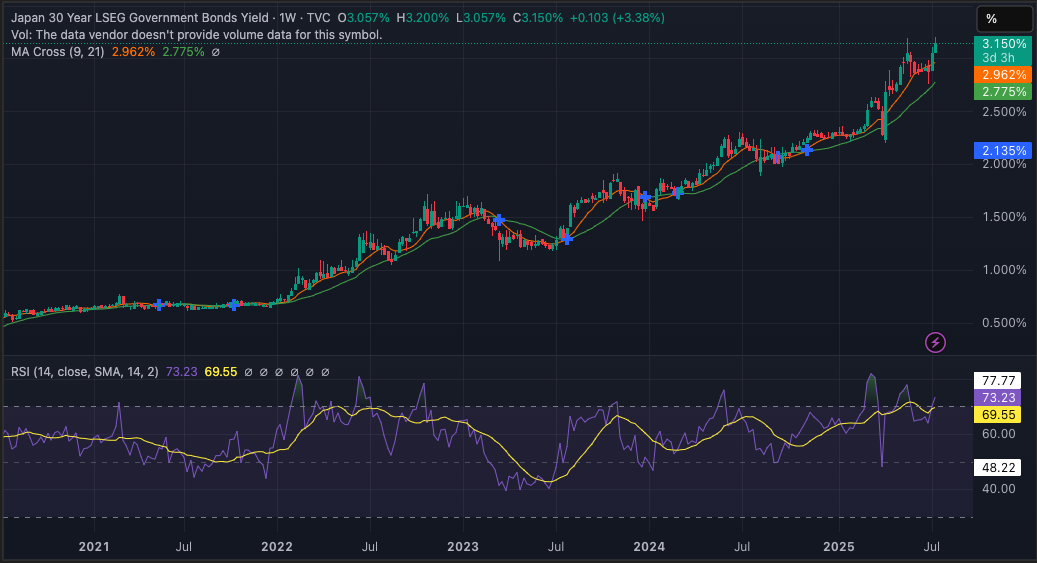
This represents a dramatic shift from the near-zero yield environment that characterized Japanese debt markets for decades. The 10-year yield, now at 1.60%, stands at its highest level since 2008. It’s the same chart.
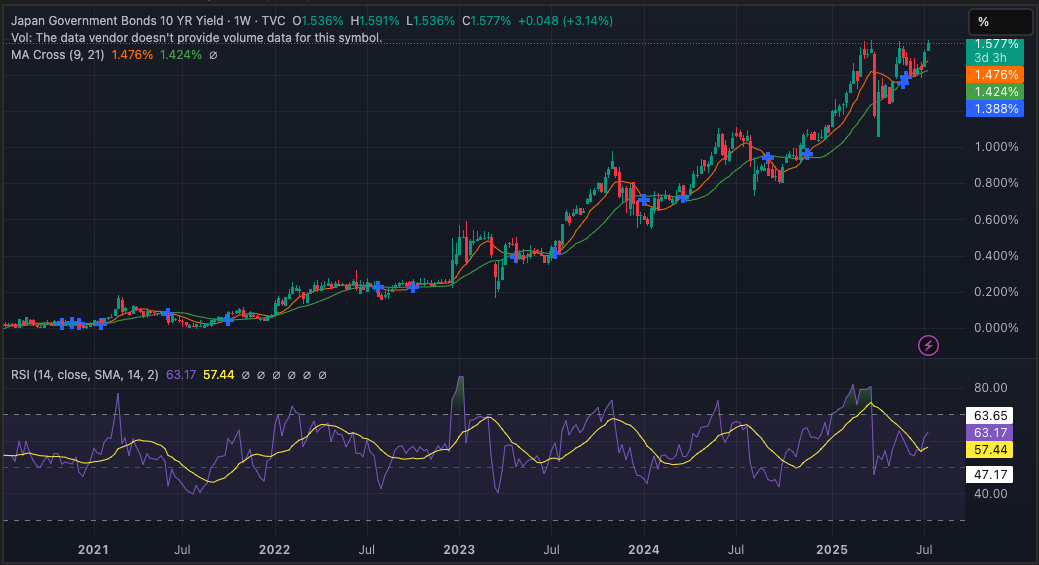
These yield spikes reflect genuine supply-demand imbalances rather than mere speculation. The bid-to-cover ratio for 40-year bonds plummeted to 2.21 in late May, marking the weakest demand since the bond's launch. Traditional buyers—life insurance companies and pension funds—have retreated as rising domestic yields reduced their liability-driven demand for duration risk.
The Bank of Japan's quantitative tightening program, initiated in July 2024, has systematically reduced monthly JGB purchases from 5.7 trillion yen to 4.1 trillion yen, with plans to reach 3 trillion yen by March 2026. This withdrawal of the market's dominant buyer—the BOJ still holds 46.3% of all JGBs—has left private investors struggling to absorb supply, creating the liquidity crisis now evident in auction results. This liquidity crisis impacts fiscal mathematics, political chess moves, trade and finance, and risks of a global deflationary spiral. It begins with the fundamentals—Japan’s debt-to-GDP is over 250%. It represents the highest burden among developed nations, but the political discourse around this figure often lacks context. The claim that 25% of the budget goes to debt service is accurate—interest payments totaled ¥28.2 trillion in fiscal 2025, up 4.5% from the previous year. However, this figure becomes more alarming when viewed dynamically rather than statically.
For instance, the Ministry of Finance now assumes a 2.0% interest rate for budget calculations, up from 1.9% in 2024. Each percentage point increase in rates could potentially add over ¥10 trillion to annual debt service costs, given the scale of outstanding obligations. We are potentially looking at much higher costs, and Ministry estimates are always conservative, which only restricts the ability of the government to fulfill its commitments. Such arithmetic creates a fiscal trap where monetary normalization becomes increasingly expensive for the government.
In the absence of real solutions, politicians do what politicians have always done - make extravagant promises in the hope of dying another day. The narrative leading up to the upcoming upper house elections has demonstrated how popular consumption relief is for a population struggling under a falling currency, with rice prices having doubled in just over a year. Opposition parties have campaigned on consumption tax cuts and increased spending, with some proposing to reduce the 10% rate by three percentage points. Such measures would create additional fiscal pressure at precisely the moment when borrowing costs are rising, potentially triggering the bond market discipline that has been absent for decades.
This excess borrowing creates a trilemma for the Bank of Japan (BoJ), which reveals the limitations of central bank omnipotence. Having raised rates to 0.50%—the highest since 2008—the BOJ must balance three incompatible objectives: maintaining price stability with inflation at 3.3%, supporting economic growth amid global trade tensions, and preventing bond market chaos that could destabilize public finances. The traditional monetary policy playbook offers no clear guidance for this situation. Further rate increases would worsen the fiscal burden and potentially trigger broader market stress. Yet maintaining current rates risks allowing inflation expectations to become entrenched, particularly given persistent wage growth and supply-side pressures from trade disputes with the United States. Higher inflation expectations drive bond yields higher, and that’s a vicious spiral that everyone wants to avoid. The BOJ's decision to slow its quantitative tightening pace from 400 billion yen to 200 billion yen quarterly adjustments starting in April 2026 represents a pragmatic acknowledgment of these market limits. This policy recalibration suggests that even the world's most experienced practitioners of unconventional monetary policy recognize the constraints imposed by fiscal arithmetic.
Despite these conditions and debt-to-GDP ratios that would trigger sovereign debt crises in other nations, Japan continues to finance itself at relatively low rates by historical standards. The 10-year yield at 1.60% remains below levels seen in most developed economies, suggesting that markets retain significant confidence in Japan's fiscal capacity. This apparent paradox reflects unique structural features of the Japanese economy that crisis narratives often ignore. Nearly 88% of Japanese government debt is held domestically, creating a closed-loop system where domestic savings automatically finance government borrowing. Japan's current account surplus provides an additional buffer, generating foreign currency earnings that support the yen and reduce external vulnerability.
The Global Spillover
The global implications of Japan's bond crisis do not lie in any specific yield that the JGBs command but instead in the cascading impact of those yields. These implications also extend beyond the well-documented carry trade dynamics, which is largely a deleveraging exercise that can upset capital flows globally. Japan's position as the largest foreign holder of U.S. Treasuries—approximately $1.13 trillion—creates direct transmission channels to global bond markets. Japanese institutions sold over $20 billion in international bonds during periods of acute stress in April 2025, demonstrating how domestic pressures can rapidly translate into global capital flows. In fact, a Goldman Sachs analysis suggests that Japan's 30-year bond has contributed approximately 80 basis points to the rise in G4 government bond yields this year. This spillover effect challenges the conventional view that Japanese bond markets operate in isolation due to domestic ownership patterns. When the world's second-largest government bond market experiences stress, global fixed income markets inevitably feel the impact.
This raises concerns of a global freeze in the bond markets as liquidity continues to dry up. The comparison to the 2008 financial crisis deserves scrutiny. While current volatility measures exceed those seen during the global financial crisis, the transmission mechanisms differ significantly. In 2008, Japan's economy contracted primarily due to export collapse as global demand evaporated. Today's crisis originates from domestic monetary and fiscal policy tensions, creating different but potentially more persistent challenges. That said, since 2008, monetary authorities around the world have developed multiple tools to ease liquidity risks during such events. However, such liquidity provisioning measures come at the cost of currency debasement, which leads inflation—and we’re back to the central banking trilemma, globally.
There are also suggestions that Japan is foreshadowing what US has coming. Indeed, US bond yields have risen much higher than the JGBs. And while there’s some truth to that, such assertions ignore the oversized impact of USD as a world reserve currency and the fact that US economy is 7X the Japanese economy. The United States faces rising debt levels and persistent fiscal deficits, but operates within a fundamentally different monetary and financial architecture. The dollar's reserve currency status provides financing advantages that Japan lacks, while U.S. demographics, though challenging, remain more favorable than Japan's trajectory.
However, the underlying tension between fiscal dominance and monetary policy independence applies across jurisdictions. As debt burdens rise globally, central banks everywhere face similar constraints in their ability to normalize monetary policy without triggering fiscal crises. Japan's current experience provides a preview of challenges that may emerge in other developed economies as populations age and debt levels rise. The key difference lies in timing and institutional frameworks. Japan's crisis unfolds against three decades of economic stagnation and demographic decline, creating unique vulnerabilities that may not translate directly to other contexts. Yet the fundamental arithmetic of debt sustainability remains universal, suggesting that Japan's struggles offer relevant lessons for global policymakers.