
Competitive Dependencies
Balanced trade means an uneasy transition

*****************************
I feel like taking a win.
*****************************
I called it immediately after Liberation Day. It was always about debt. The trade deal investment commitments are about debt. It’s all about debt.
But we’re not in April anymore. The game has moved on. And so has this Substack.
We’ve said an absent-minded goodbye to the old world, unsure what lies ahead. We’re in the world of American Etatism, which I introduced in my last post.

Today I want to capture the global implications of this Etatistic transformation undertaken by Messrs Trump & Co.
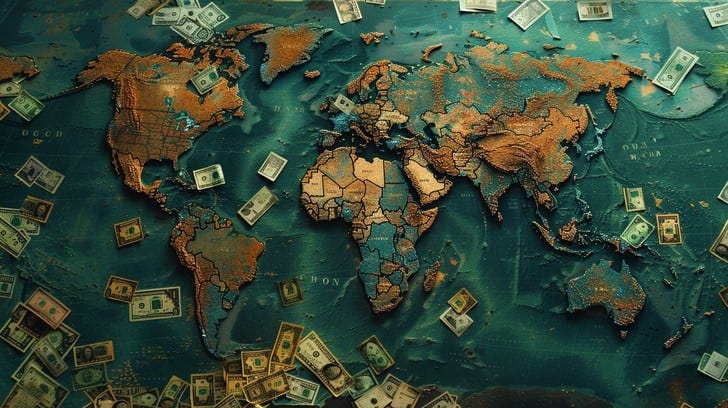
American etatism has set off something unexpected: a global scramble for capital that will reshape the economic order for decades. By centralizing state power and extracting resources from allies through commanded trade agreements, the U.S. is creating air pockets of capital in the rest of the global economy forcing capitalists to be judicious in the decisions. The initial response is predictable—risk-averse money has fled to American safe havens, Treasuries (as highlighted above), regulated stablecoins, and assets protected by executive decree. But this gravitational pull creates its own counter-forces, as the rest of the world adapts to a reality where traditional partnerships no longer guarantee prosperity.
The mechanics of this transformation are already visible. Europe has commited $750 billion in energy purchases and $600 billion in investments to the United States by 2028. Japan has pledged $550 billion in strategic sectors. These arrangements do more than transfer wealth—they constrain the fiscal space of America's allies, reducing their capacity for domestic investment and consumption. As the United States rebuilds manufacturing through this extracted capital, American real consumption must necessarily decline relative to production, i.e., we should see the share of consumption as a percent of GDP go down. The math is simple, yet unforgiving. We can already see cuts in policies supporting consumption—the federal students loan program has resumed collections on student debt, fraud payments amounting to billions of dollars as part of social security are being canceled, numerous government consulting programs have been terminated, Fannie Mae and Freddie Mac are being considered for privatization, and of course, institutions like USAID have been shut down. All of this adds up to several hundred billions of dollars that will no longer aid consumption in America. To add to that, illegal immigration has dropped to zero while deportations continue unabated. All of these policies reduce demand and as such consumption.
What emerges is a structural shift: a deliberate reduction in domestic consumption to make room for renewed American production, but at significant social and economic costs. While the transition will be difficult for America domestically, it will also necessitate a new vision to foreign policy. While in the short term the planned investments will aid economic growth, as the transition achieves economies of scale, America will find itself in much the same position as the biggest exporters in the world—dependent on rising consumption in the rest of the world.
This means growth must increasingly depend on finding and serving new external markets, most notably in the young and fast-growing economies that currently stand outside the American sphere of extraction. The consequence is a new form of vulnerability—America’s ability to reap the rewards of its industrial realignment will hinge not just on domestic policy, but on the willingness and capacity of the rest of the world, especially the Global South, to act as consumers of American output. In other words, as the U.S. turns inward to concentrate state power and outward to capture capital, it becomes ever more reliant on the very regions and nations it cannot directly coerce. I want to reiterate that this is not a short term threat but the seeds that Trump is sowing will eventually blossom into flowers whose demand will lie outside of America. This is also why a weak Chinese consumer is a worry not just for Xi, but also for Trump. But outside of China, two countries that stand out for an immense consumer base are India and Brazil.
India and Brazil represent the consumption powerhouses that America's new industrial strategy will increasingly depend upon. India's consumer market has demonstrated remarkable resilience, with private final consumption expenditure growing 7.2 percent annually even as overall GDP growth moderated, adding 100 million middle-class households by 2030 and positioning major cities as primary drivers of consumer spending across Asia Pacific. The country's transformation is evident in corporate strategies: OpenAI has made India its second-largest market globally, launching ChatGPT Go at ₹399 (< $5) monthly to capture price-sensitive consumers, while Perplexity partnered with Airtel to offer free subscriptions to 360 million users, recognizing that India's downloads surged 600 percent year-over-year. The broader trend encompasses both services and goods industries—Indian e-retail has reached $60 billion in gross merchandise value with the world's second-largest online shopper base, while companies from TCS to UPL now derive roughly 50 percent of their revenue from Brazilian-Latin markets rather than domestic operations.
Brazil's consumer dynamics offer a different but complementary appeal, with household spending projected to reach BRL 3.2 trillion ($576 billion) in 2025, representing 14.3 percent growth above pre-pandemic levels despite headwinds from rising inflation and interest rates. The country's strategic positioning attracts both Western and Eastern investment—Microsoft committed $2.7 billion over three years to enhance cloud and AI infrastructure, while China has established $73 billion in investment stock focused on energy and manufacturing. Brazil's consumption patterns favor American enterprise in specific sectors: the country's IT market surged 13.9 percent in 2024, outpacing global averages, while 90 percent of large Brazilian firms have implemented AI applications, creating demand for American technology services. The demographic tailwinds are also substantial—tight labor markets support real wage growth above 3.5 percent annually, while government initiatives like the National AI Strategy allocate $4 billion for infrastructure development, positioning Brazil as Latin America's entry point for digital technologies.
So, Trump's focus on securing short-term advantages against broader BRICS initiatives may undermine long-term American interests in precisely these markets. His repeated threats of 100 percent tariffs on BRICS nations that challenge dollar dominance—escalated to immediate 10 percent levies for mere membership—stem from concerns that the bloc "was set up to hurt us" and "degenerate our dollar". While the ambitious concept of a unified BRICS currency remains stalled due to internal disagreements, particularly India's resistance to yuan dominance and Brazil's preference for local currency transactions over monetary integration, the pressure tactics risk alienating the very economies America needs most. India and Brazil, as the democratic anchors within BRICS, have historically served as moderating influences against the anti-Western narratives pushed by China and Russia. By treating them as adversaries rather than partners, Trump's approach may drive these swing powers deeper into Chinese and Russian orbits, sacrificing access to the world's fastest-growing consumer markets for the sake of symbolic dollar protection. The irony is profound: in seeking to preserve dollar hegemony through coercion, American policy may accelerate the very de-dollarization it seeks to prevent, while forfeiting the consumption growth that America's new industrial model desperately requires.
What’s also lost in geo-political analysis is culture and trajectory. Both India and Brazil are on the rise and when the economy is young and growing, it impacts how people perceive their national identity. Both people have a proud history and have built their substantial progress on domestic ingenuity instead of western lectures. Too often we forget that behind all economics and statecraft, lies something more fundamental: humanity itself. It is often not simply strength but persistence and pride that wins the day. In India’s case, America also has experience of being caught flat footed. The world witnessed it in 1971 when Indira Gandhi was voted the most admired person globally after she stood up to American bullying, put Nixon in his place, and secured the freedom of Bangladesh. That moment revealed a truth that pure economic analysis often misses—nations and their leaders can choose dignity over submission, even when the immediate costs are severe. Gandhi's defiance resonated across the developing world precisely because it demonstrated that American power was not absolute, that courage could triumph over coercion, and there was another path besides American allegiance and communism. It’s one of the reasons why India enjoys substantial soft power today, the kind of soft power America once carried.
India and Brazil are not just large economies with favorable demographics—they are democracies with influence throughout the Global South. Their ability to resist American economic dominance while maintaining growth and international respect creates a model that dozens of other nations observe carefully. When countries that have spent much of the last century being subservient to the Global North see India negotiating as an equal or Brazil charting an independent course, it changes the calculus of what seems possible and adds to the resistance to American economic dominance which is manifesting across three distinct tiers.

China and Russia form the core opposition, leveraging their "no-limits" partnership through $200 billion in bilateral trade, alternative payment systems like mBridge connecting 150 countries, and yuan-ruble settlements reaching 90 percent of their commerce. Yet both face internal constraints: China is struggling with deflationary pressures and overcapacity, while Russia is operating under sanctions that limit its financial maneuverability. Their response is thus outward-looking by necessity—China must export capital to generate returns, Russia must find new partners for its resource wealth.
The swing powers of India and Brazil occupy the crucial middle ground. Their democratic institutions and growth trajectories attract capital seeking both returns and political stability. Unlike authoritarian alternatives, these markets offer legal predictability and transparent governance that global investors increasingly value. India's projected addition of 100 million middle-class households creates consumption opportunities that neither Europe nor Japan can match in their constrained circumstances. Brazil's positioning between American and Chinese spheres provides hedging opportunities that pure alignment cannot deliver. More importantly, these countries demonstrate that resistance is possible. When America gives up its soft power through economic coercion, it creates pathways for other nations to make the decision to take the pain and preserve their pride. This should not be underestimated. A weak Europe, a struggling Japan, and more than timid Canada and the UK limit American ability to project power through traditional allies. The vassal states that once amplified American influence are themselves now subjects of extraction rather than partners in projection.
The Global South represents the wildcard in this emerging system. BRICS recently expanded to include major economies and create a bloc representing 45 percent of global population and 40 percent of economic output. These nations control critical resources, agricultural production, and increasingly sophisticated manufacturing capabilities. As American allies face extraction and stagnation, Global South markets become the primary destinations for both Western capital seeking growth and Eastern capital seeking diversification. This also creates opportunities for heavyweights like China whose role may evolve from a goods exporter to a capital exporter as Xi seeks a balance within his own economy. With domestic deflation limiting internal opportunities, Chinese financial resources are likely to flow outward through Belt and Road infrastructure, equity investments, and development banks. The New Development Bank approval of $32 billion in projects across member countries create new alternatives to the World Bank. We can already see Chinese investments in Indian manufacturing, Brazilian agriculture, and African infrastructure establishing networks independent of American financial systems.
These developments will mold capital flows which will follow the new patterns of the ensuing global race for capital. These patterns will be defined by safety and opportunity. America provides safety with the deepest, most liquid markets in the world. But India and Brazil offer better returns on capital, especially as their young populations drive consumption growth that mature economies cannot match. Growth-seeking money is already migrating toward these markets where demographics and policy reforms create genuine expansion rather than the managed stagnation we see in Europe and Japan.
The race will only get more intense as American capital controls continue to tighten. Trump administration has introduced selective filtering through tax penalties and jurisdictional discrimination that fragments global financial flows. This actually elevates the value of neutral intermediaries and creates premium returns for markets outside American regulatory reach. As a result, Singapore's role as a financial bridge between systems is expanding. The UAE has become crucial for commodity financing and alternative settlement systems while Switzerland has maintained its position as the neutral safe haven for wealth seeking political diversification. These countries capture outsized rents precisely because they avoid taking sides in this emerging bipolar contest.
Technology, especially in finance, will add another dimension that cannot be ignored. American control over stablecoins provides monetary leverage that the earlier Eurodollar system lacked, giving Washington unprecedented power to monitor and potentially restrict global dollar flows in real time. While it will take a few years to expand the stablecoin network, these networks will also enable alternative payment systems that bypass traditional financial intermediaries entirely. The race has become not just about capital but about the infrastructure that moves capital—payment systems, settlement networks, trade financing mechanisms, and digital currencies. China's mBridge system connecting 150 countries represents an early attempt to create this alternative infrastructure, while Russia's SPFS provides backup settlement capability independent of SWIFT.
The world has not yet reached the point where the Global South collectively chooses to align one way or other, but the foundations are clearly being laid. Trump's approach of extracting more from allies while tightening controls on capital and demanding greater submission creates the very conditions where other nations might choose a harder but more independent path which could play directly into BRICS hands, especially as their influence continues to grow across multiple sectors of the global economy. What is emerging in front of us is not a hegemony or even the bipolarity of cold war, but something messier and more interesting. America can extract resources and concentrate power, but in doing so it also creates a dependence upon the rest of the world to buy what it produces.
This evolving equilibrium incentivizes every player to hedge. The U.S. will continue to enforce new rules to keep capital anchored at home and exert leverage abroad, but the rest of the world is already building redundancy, seeking out new partners and inventing new financial plumbing to avoid being at the mercy of Washington’s decisions. The real test for America’s etatist experiment lies ahead. It remains to be seen whether the U.S. can maintain high returns and stability for its investors and industries in the long run while restricting the growth ambitions of others. If it cannot, capital will increasingly seek out new frontiers—not simply to escape regulation, but because real growth and opportunity will reside elsewhere. Meanwhile, as the American approach hardens, countries with the ability to offer both returns and autonomy will shape the character of the next global cycle.
Nice one 👍🏻