
Cobra Effect

“When you are up to your neck in alligators, it is hard to remember that the original intention was to drain the swamps” — Unknown
In colonial Delhi, British administrators were faced with a peculiar public safety issue. The Cobra, a venomous snake native to the Indian subcontinent, had bitten enough people to create public panic, and as the incidents continued to rise, the authorities knew they had to do something. Their solution was inherently British, appearing elegant but demonstrably dumb. The British decided to offer bounties for dead cobras to incentivize the elimination of the threat. The people, rendered poor under the British Raj, responded by killing Cobras and presenting the dead ones to collect bounties. The policy seemed to have worked, at least initially. Cobra carcasses began piling up at government offices, and snake sightings declined. However, what the policy also created was a reliable income stream in a poor economy with a high unemployment rate. A new incentive structure was born—it became more profitable to breed cobras for slaughter than to hunt wild ones. Seeing their policies backfire, the British canceled the program to prevent further misuse through perverse entrepreneurship. The “entrepreneurs” were now left without a market to sell their Cobras and released their now-worthless inventory into the wild, making Delhi's cobra problem worse than ever.
(So, the next time you hear a racist trope like “snake charmers” about Indians, remember it’s less about racism and more about bureaucratic incompetence.)
This episode, which economist Horst Siebert later termed the "Cobra Effect," illustrates a fundamental truth about public policy: well-intentioned interventions can backfire spectacularly when policymakers fail to anticipate how rational actors will respond to new incentive structures. The cobra bounty program failed not because of malicious intent or poor execution, but because it created incentives that were orthogonal to its stated objectives.
The Cobra Effect is also not an anomaly but a recurring pattern that emerges whenever complex systems encounter simplified interventions. The formation of the Organization of Petroleum Exporting Countries (OPEC) can be traced to a similar Cobra Effect. The initial move to form this union was to restore balance in oil trade and secure fairer terms after the “Seven Sisters” cartel of Western oil companies dominated the oil markets, often to the detriment of OPEC countries. But soon after, OPEC began to transform into a much more powerful organization. By the 1970s, OPEC had evolved from a defensive alliance into an assertive cartel capable of triggering global oil shocks through coordinated production cuts and embargoes.
President Hoover in the U.S. embarked on what he called "a great social and economic experiment, noble in motive and far-reaching in purpose" when he implemented Prohibition in 1920. The law meant to encourage respect for authority instead bred cynicism and lawlessness, while government attempts to poison industrial alcohol supplies led to thousands of deaths. By its repeal in 1933, Prohibition had achieved the opposite of its intentions: it diminished faith in government, devastated legitimate businesses, and established organized crime networks that persisted for decades. The Cobra Effect.
In 1958, Mao Zedong launched the Four Pests Campaign, targeting sparrows among other creatures believed to damage agricultural output. The campaign mobilized millions of Chinese citizens to eliminate sparrows, which were seen as grain-eating pests that reduced harvests. However, sparrows also consumed crop-destroying insects. With their natural predator eliminated, locust populations exploded, devastating crops and contributing to the Great Chinese Famine. The intervention designed to increase food production instead helped precipitate one of history's worst famines. The Cobra Effect.
But why are we going down this particular road of history? Because I want to present a case that we are currently in the middle of yet another Cobra Effect. A Cobra Effect that will impact every single person on the planet by upending the monetary system that all of us have come to rely on.
The Monetary System's Cobra Effect
Contemporary monetary policy exhibits the same incentive-outcome misalignment that characterizes the cobra effect. Central banks expand money supplies to stimulate economic growth, but this intervention creates incentives that may ultimately undermine the same economy that the central bankers seek to stimulate. Let’s begin with an often-cited chart in the world of crypto: Global M2 against Bitcoin and Gold.
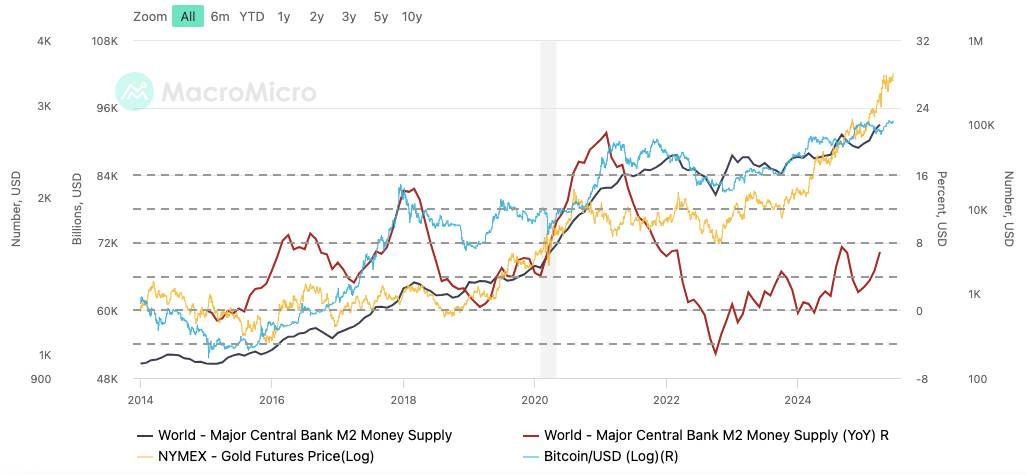
The chart makes clear the strong correlation between the prices of gold and Bitcoin and the expansion of global M2 money supply. Historically, gold’s role as a monetary hedge is deeply rooted—long before fiat currencies, merchants and central banks would accumulate reserve currencies but ultimately convert excess into gold, the ultimate store of value. This tradition allowed the gold standard to persist for centuries and persists today: even in the fiat era, gold remains a cornerstone of central bank reserves and a classic hedge against both inflation and geopolitical turmoil. When central banks buy gold, they are not rejecting the system; rather, they are engaging in defensive diversification—purchasing insurance against monetary and political risk while signaling continued faith in the underlying financial architecture.
Bitcoin, by contrast, represents a fundamentally different response to monetary expansion. While it is often called “digital gold” and shows a strong correlation with global liquidity, its flows are not simply about hedging within the system. Instead, Bitcoin’s surging adoption—especially among technology-forward investors and institutions—reflects a systematic rejection of the traditional monetary order. Allocating to Bitcoin is not just about diversification; it is about seeking an exit from fiat-based frameworks altogether. This is evident in the explosive growth of institutional Bitcoin holdings, which have more than doubled in recent quarters. Bitcoin’s rise is thus not just a mirror of gold’s defensive role, but a signal of growing philosophical divergence: where gold hedges against policy failure while maintaining trust in institutions, Bitcoin embodies a loss of confidence in the system’s ability to reform itself.
This capital allocation divide has profound implications for economic development. In a healthy system, capital flows across the risk curve—from the safety of gold and Treasuries, through established businesses, to innovative ventures—fueling broad-based growth. But as both traditional capital (seeking safety in gold) and innovator capital (seeking escape in Bitcoin) accelerate their outflows from productive assets, the pool of capital available for real economic activity contracts. This dynamic creates a self-reinforcing cycle: monetary expansion, intended to stimulate growth, instead drives capital into hedges and alternatives, further undermining growth and deepening skepticism about the system’s viability. The result is a modern Cobra Effect, where the very solutions designed to stabilize the system become the source of its instability.
I’d like to highlight two key phenomena here that are intrinsically linked to the monetary Cobra Effect.
The Depressed Fiscal Multipliers: The most telling indicator of the monetary system's cobra effect lies in declining fiscal multipliers across major economies. I covered it at length last week, but to summarize, in the United States, the fiscal multiplier has dropped to 0.4, meaning each dollar of government spending generates only 40 cents of economic output. China's situation is even more dire, with fiscal multipliers around 0.15, indicating that $1 of stimulus produces merely 15 cents of growth. These figures represent the two largest economies in the world failing to achieve effective stimulus despite massive monetary expansion. This decline in fiscal effectiveness creates a perverse cycle: as governments recognize their stimulus efforts are failing, they respond by printing more money, but the additional liquidity increasingly flows toward Gold and Bitcoin rather than growth-generating investments. The very act of expanding the money supply to stimulate growth creates incentives for capital to flee toward stores of value that offer protection from currency debasement.
The Capital Market Unraveling: Central bank gold purchases have reached unprecedented levels, with global holdings approaching 36,000 metric tons in 2024—near the historic highs of 38,000 metric tons reached in the mid-1960s during the Bretton Woods era. Central banks purchased over 1,000 tonnes of gold annually from 2022 to 2024, representing twice the average rate of the previous decade. This institutional flight to gold has made it the world's second-largest reserve asset after the dollar, comprising approximately 20% of global official reserves. This reallocation represents a fundamental shift in capital deployment. But more importantly, it represents a loss of faith and a belief fracture at the most fundamental layer of our present monetary system—the central banks. Poorly developed capital markets are often characterized by excessive weight given to hard assets in financial allocation, which creates a systematic bias away from productive but less tangible investments. The Cobra Effect is in full flow as this dynamic becomes a characteristic of developed markets as well, and the appeal of hard assets continues to grow in response to monetary uncertainty.
Global Consequences
The global monetary system now confronts a terminal phase of the Cobra Effect, where central banks have fundamentally lost control of the very mechanisms they created to stabilize the economy. Their desperate attempts to maintain relevance through increasingly experimental tools—negative interest rates, unlimited quantitative easing, and direct market interventions—have only accelerated the capital flight they sought to prevent. The data reveal the stark reality: monetary policy effectiveness has collapsed under persistently low rates, with GDP responses to easing becoming weaker and fiscal balances deteriorating precisely when stimulus is most needed. Central banks, once revered as omnipotent guardians of financial stability, now resemble the British colonial administrators in Delhi, frantically canceling programs that have unleashed forces beyond their control.
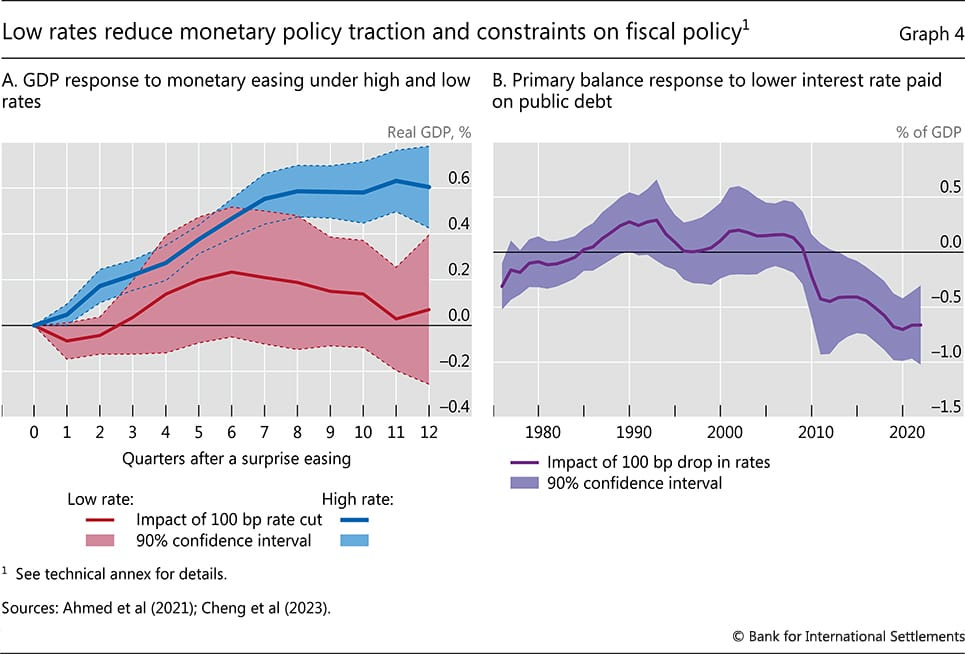
The endgame now appears inevitable as both traditional capital and innovator capital simultaneously abandon productive investment for alternative stores of value. With 75 of the world's poorest countries facing a "tidal wave" of Chinese debt repayments totaling $22 billion in 2025, while developed economies grapple with debt-to-GDP ratios far exceeding wartime levels, the global financial system faces systemic breakdown. Central banks have exhausted their conventional toolkit and find their unconventional measures producing diminishing returns, yet they cannot reverse course without triggering the very crises they have postponed. The slow-motion collapse unfolds as capital continues its exodus from productive assets toward gold and Bitcoin, starving real economic activity of the investment it desperately needs, while central banks print more money that only accelerates the flight.
The specter of violent resolution looms as geopolitical tensions reach levels not seen since the height of the Cold War, with surveys showing that over 40% of Europeans and Americans believe World War III is likely within the next 5-10 years. The current monetary crisis mirrors the conditions that preceded the original Bretton Woods conference in 1944, when global economic chaos and world war necessitated a complete reconstruction of the international financial system. Today's combination of unsustainable debt levels, failed monetary policies, and rising nationalism creates the same combustible mixture that historically has resolved itself through conflict rather than negotiation. The tragic irony is that central banks, in their attempts to prevent economic collapse through monetary expansion, may have made violent conflict more likely by creating the very instability and inequality that fuels geopolitical tensions.
History suggests that monetary systems, like empires, rarely expire peacefully—they are typically swept away by the forces they cannot contain. As the current Cobra Effect reaches its logical conclusion, with central banks having lost both the tools and credibility to manage the crisis of their own making, the world faces a choice between orderly transition to a new monetary framework or the violent restructuring that has historically accompanied such systemic breakdowns. The hope for a peaceful resolution diminishes as each day passes, with policymakers clinging to failed paradigms, their continued interventions only deepening the contradictions that make conflict increasingly inevitable. Whether the next Bretton Woods emerges from negotiation or devastation may well depend on how quickly the world recognizes that the current monetary system has already failed, and that attempting to preserve it through ever more desperate measures only hastens the day of reckoning.